
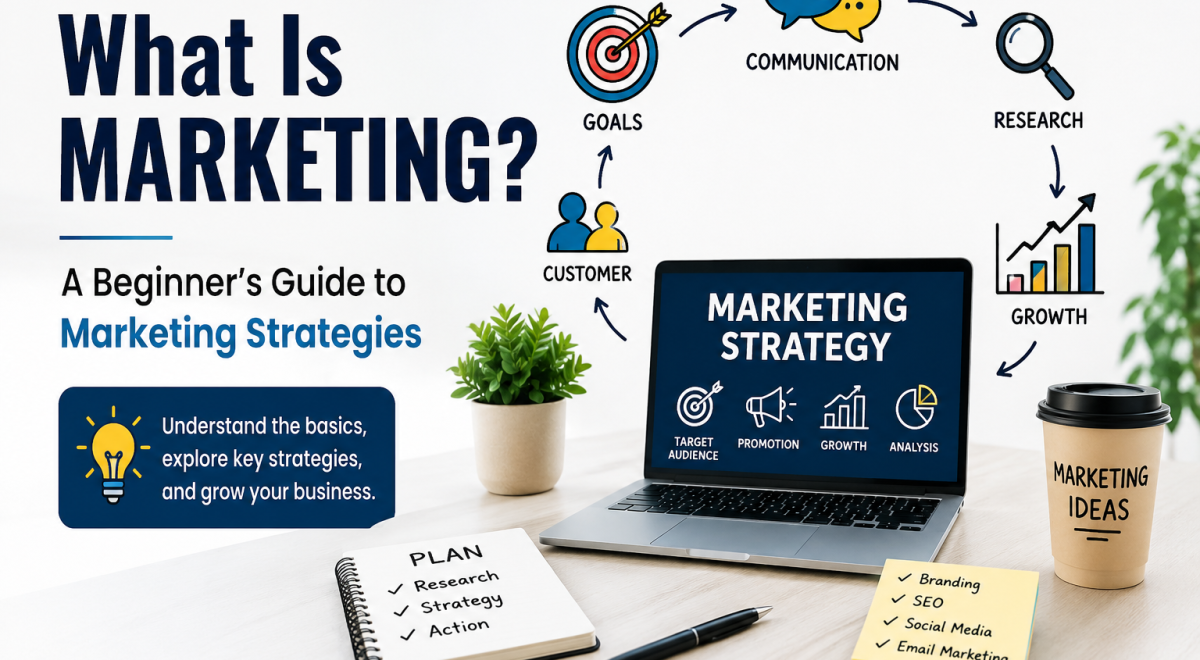
Introduction
Marketing is an important part of almost every business. Whether a company sells physical products, provides services, publishes digital content, or operates entirely online, marketing helps it communicate with potential customers and explain why its offering may be useful.
But what is marketing exactly?
In simple terms, marketing is the process of understanding customers, creating value for them, communicating that value, and making products or services available in ways that encourage appropriate customer action. It involves much more than advertising. Research, branding, pricing, content, customer relationships, sales support, and digital channels can all play a role.
This beginner’s guide explains what is marketing, how marketing works, the major types and strategies, common channels, useful examples, and mistakes beginners should avoid.
Marketing is a broad business activity focused on connecting an organization’s products or services with the people who may need or want them.
What Is Marketing?
A simple way to understand marketing is to think about five questions:
- Who are you trying to reach?
- What problem or need do they have?
- What are you offering to help them?
- Why should they consider your offer?
- How can you communicate with and serve them effectively?
For example, imagine a small company that sells reusable water bottles.
Its marketing activities might include researching what customers want, designing a suitable product, deciding on pricing, creating a recognizable brand, publishing useful content, promoting the product on social media, and making it easy for customers to purchase.
Advertising may be part of this process, but advertising alone is not the whole of marketing.
Why Is Marketing Important?
Marketing helps businesses understand their audiences and communicate with them more effectively.
1. It Helps Businesses Understand Customers
Good marketing starts with learning about the people a business wants to serve.
Customer research can reveal:
- Common problems
- Preferences
- Buying motivations
- Questions and concerns
- Preferred communication channels
- Factors that influence purchasing decisions
This information can help businesses make better decisions about their products and communication.
2. It Communicates Value
A product may be useful, but potential customers need to understand what it does and whether it is relevant to them.
Marketing communicates information about:
- Features
- Benefits
- Pricing
- Availability
- Product differences
- Ways to use a product or service
Clear communication can make it easier for people to evaluate an offer.
3. It Builds Brand Awareness
Branding helps people recognize and distinguish one business from another.
A brand can include elements such as:
- Name
- Logo
- Visual identity
- Tone of communication
- Customer experience
- Reputation
Consistent branding can help a business establish a recognizable identity.
4. It Supports Customer Relationships
Marketing is not only about attracting new customers.
Businesses can also use email, educational content, social media, customer support, and other communication methods to maintain relationships with existing customers.
5. It Helps Businesses Compete
In many markets, customers have several options.
Marketing gives businesses an opportunity to explain how their products or services differ from alternatives and who they are designed to help.
How Does Marketing Work?
Marketing usually involves several connected stages rather than one single activity.
Step 1: Research the Market
Before creating a marketing plan, a business should understand the market it operates in.
Research may involve studying:
- Potential customers
- Competitors
- Market trends
- Customer problems
- Existing products
- Pricing approaches
The goal is to make decisions based on useful information rather than assumptions.
Step 2: Identify the Target Audience
A business cannot effectively communicate with everyone using exactly the same message.
A target audience is a specific group of people a product or service is intended to serve.
For example, a company selling beginner photography courses might focus on people who want to learn photography but have limited experience.
Step 3: Define the Value Proposition
A value proposition explains why a customer might consider a particular product or service.
It should clearly communicate:
- What is being offered
- Who it is for
- What need it addresses
- What makes the offer relevant
A strong value proposition should be clear rather than exaggerated.
Step 4: Choose Marketing Channels
Businesses can communicate with customers through different channels.
These may include:
- Search engines
- Websites
- Social media
- Video platforms
- Online advertising
- Events
- Print materials
- Partnerships
The best channel depends on the audience, objectives, resources, and type of business.
Step 5: Create and Publish Useful Content
Content marketing can help businesses educate audiences and answer their questions.
Examples include:
- Blog articles
- Tutorials
- Videos
- Guides
- Case studies
- Infographics
- Newsletters
Useful content should provide genuine value rather than exist only to promote a product.
Step 6: Measure Results
Marketing activities should be evaluated.
Depending on the campaign, businesses may examine measures such as:
- Website visits
- Search visibility
- Engagement
- Leads
- Sales
- Email responses
- Customer retention
Not every metric is equally important. A business should choose measurements that relate to its actual objectives.
What Are the Main Types of Marketing?
Marketing has many different forms. Some of the most common include the following.
Digital Marketing
Digital marketing uses online channels to communicate with audiences.
Examples include:
- Search engine optimization
- Email marketing
- Social media marketing
- Content marketing
- Online advertising
- Video marketing
Digital marketing can be useful because businesses can reach audiences through websites, search engines, apps, and other online platforms.
Content Marketing
Content marketing focuses on creating and distributing useful, relevant content for a defined audience.
For example, a software company might publish tutorials that explain how to solve common problems related to its industry.
The content can help people learn while also introducing them to the company.
Social Media Marketing
Social media marketing uses platforms such as social networks and short-form video services to communicate with audiences.
Businesses may use social media to:
- Share educational content
- Introduce products
- Answer questions
- Build communities
- Communicate announcements
- Receive customer feedback
Results can vary considerably depending on the platform, audience, content, and consistency.
Search Engine Marketing
Search engine marketing involves promoting visibility through search engines.
It can include paid search advertising and other search-focused activities.
Businesses need to distinguish paid advertising from organic search visibility because they work differently and have different costs and requirements.
Search Engine Optimization
Search engine optimization, commonly called SEO, focuses on improving a website’s ability to appear in relevant organic search results.
SEO activities can include:
- Creating useful content
- Improving website structure
- Using descriptive page titles
- Making websites easier to navigate
- Improving page experience
- Earning relevant links and mentions
SEO does not guarantee a particular ranking or amount of traffic.
Email Marketing
Email marketing involves communicating with people through email, usually with permission.
Businesses may use email for:
- Newsletters
- Product information
- Educational content
- Updates
- Customer communication
Effective email marketing should respect privacy, applicable laws, and subscriber preferences.
Influencer Marketing
Influencer marketing involves working with individuals who have an established audience or community.
A business may collaborate with a creator whose audience is relevant to its product.
Transparency is important when promotional relationships exist. Advertising and sponsorship disclosures should follow applicable rules and platform requirements.
What Is a Marketing Strategy?
A marketing strategy is a structured approach for achieving marketing objectives.
It explains how a business intends to reach its target audience and communicate its value.
A basic marketing strategy may include:
- Business objectives
- Target audience
- Market research
- Value proposition
- Positioning
- Marketing channels
- Content approach
- Budget
- Performance measurements
- Review and improvement process
A strategy provides direction, while individual campaigns are specific activities carried out within that broader plan.
The 4 Ps of Marketing
One traditional framework for understanding marketing is the 4 Ps:
Product
The product is what a business offers to customers.
It may be a physical product, service, software, subscription, course, or another type of offering.
Price
Price is what customers pay for the product or service.
Pricing decisions may consider costs, customer expectations, competitors, positioning, and business objectives.
Place
Place refers to how and where customers can access the product.
For example, products may be sold through:
- Physical stores
- Websites
- Marketplaces
- Distributors
- Sales teams
Promotion
Promotion covers communication activities used to inform audiences about an offering.
Examples include:
- Advertising
- Public relations
- Content
- Social media
- Sales promotions
The 4 Ps are a useful framework, but modern marketing often considers additional factors, particularly for services and customer experiences.
Marketing Strategy vs. Marketing Tactics
These terms are related but different.
Strategy describes the overall direction.
Tactics are the specific actions used to implement that strategy.
For example:
Strategy: Reach beginner photographers who want affordable learning resources.
Tactics:
- Publish beginner photography guides
- Create educational videos
- Build an email newsletter
- Optimize relevant articles for search
- Promote selected content on social platforms
A business can use many tactics without having a clear strategy. That can make marketing activities disconnected and difficult to evaluate.
Traditional Marketing vs. Digital Marketing
| Traditional Marketing | Digital Marketing |
| Television advertising | Search advertising |
| Radio | Social media |
| Newspapers | Email marketing |
| Magazines | SEO |
| Billboards | Content marketing |
| Direct mail | Video marketing |
Neither category is automatically better for every business.
The right approach depends on factors such as the target audience, objectives, budget, location, product, and customer journey. Some businesses use a combination of traditional and digital channels.
How to Create a Simple Marketing Strategy
Beginners do not need an overly complicated plan.
1. Set a Clear Objective
Start with a specific goal.
For example:
Increase awareness of a new online course among beginner learners.
A clear objective makes it easier to decide which activities are relevant.
2. Define Your Audience
Describe the people you want to reach.
Consider their:
- Needs
- Problems
- Interests
- Experience level
- Buying behavior
- Preferred communication channels
3. Study Your Competitors
Look at how similar businesses present themselves.
Pay attention to:
- Products
- Pricing
- Content
- Positioning
- Customer experience
- Marketing channels
The goal is not to copy competitors. It is to understand the market and identify opportunities to provide something useful or distinctive.
4. Choose a Few Relevant Channels
You do not need to use every marketing platform.
Choose channels where your target audience is likely to spend time and where you can consistently provide useful content.
5. Create Helpful Content
Answer real questions from your audience.
For example, a website about digital marketing could publish:
- Beginner guides
- Step-by-step tutorials
- Tool comparisons
- Strategy explanations
- Common mistakes
- Practical checklists
6. Track Meaningful Results
Monitor results related to your objective.
If the objective is brand awareness, visibility and relevant engagement may be useful indicators. If the objective is generating leads, qualified inquiries may be more meaningful.
7. Improve the Strategy
Marketing is often an ongoing process.
Review what is working, what is not working, and what can be improved. Avoid making major decisions based on very limited information.
Common Marketing Mistakes Beginners Should Avoid
Trying to Reach Everyone
A broad audience can make messaging unclear.
A more defined audience often makes it easier to create relevant content and communication.
Focusing Only on Promotion
Constantly promoting products can make content less useful.
Educational and informative material can help audiences understand problems and possible solutions.
Ignoring Customer Feedback
Customers can provide valuable information about product problems, confusing messaging, and unmet needs.
Using Too Many Channels
Managing multiple platforms without enough resources can lead to inconsistent content.
It is often better to manage a smaller number of relevant channels well.
Measuring Vanity Metrics Alone
Large numbers of views, followers, or impressions do not necessarily mean that a marketing campaign is achieving its business objective.
Metrics should be interpreted in context.
Making Unsupported Claims
Marketing should accurately represent products and services.
Claims about performance, pricing, results, or benefits should be truthful and supported by appropriate evidence.
Benefits and Limitations of Marketing
Marketing can provide several benefits, but it also has limitations.
Benefits
- Helps businesses understand customers
- Improves communication
- Builds brand awareness
- Supports product discovery
- Creates opportunities to attract customers
- Helps businesses understand market demand
- Supports relationships with existing customers
Limitations
Marketing does not guarantee sales.
A campaign can fail because of factors such as poor product-market fit, pricing problems, weak customer experience, competition, limited demand, or ineffective execution.
Marketing also requires resources. Depending on the approach, costs may include advertising, software, content creation, employees, agencies, research, and other operational expenses.
What Makes Marketing Effective?
Effective marketing generally starts with a clear understanding of the customer.
A useful approach is to:
- Solve a genuine problem
- Understand your audience
- Communicate clearly
- Provide useful information
- Choose appropriate channels
- Test reasonable approaches
- Measure meaningful outcomes
- Improve based on evidence
- Be honest about products and results
Marketing works best when the product or service actually provides value. Strong promotion cannot permanently compensate for an offering that does not meet customer expectations.
Frequently Asked Questions
1. What is marketing in simple words?
Marketing is the process of understanding customers, creating and communicating value, and connecting products or services with people who may need them.
2. What is the difference between marketing and advertising?
Advertising is one part of marketing. Marketing is broader and can include research, product decisions, pricing, branding, content, customer relationships, distribution, advertising, and other activities.
3. What are the 4 Ps of marketing?
The traditional 4 Ps are Product, Price, Place, and Promotion. They provide a simple framework for thinking about important marketing decisions.
4. What is a marketing strategy?
A marketing strategy is a plan that explains how a business intends to reach its target audience, communicate its value, and work toward specific marketing objectives.
5. Is digital marketing the same as marketing?
No. Digital marketing is a part of marketing that uses digital channels. Marketing also includes offline activities such as events, print, direct mail, physical retail, and other approaches.
Conclusion
Understanding what is marketing is the first step toward creating better marketing decisions.
Marketing is much broader than advertising. It involves understanding customers, identifying their needs, developing valuable offerings, communicating clearly, choosing appropriate channels, and building lasting relationships.
For beginners, the best approach is to start with a clear audience and objective rather than trying to use every available marketing channel. Research your market, provide genuinely useful information, measure meaningful results, and improve your strategy over time.
Good marketing is ultimately about creating a useful connection between people and value. When businesses understand their customers and communicate honestly, marketing becomes more than promotion—it becomes an important part of building a sustainable business.