
Introduction
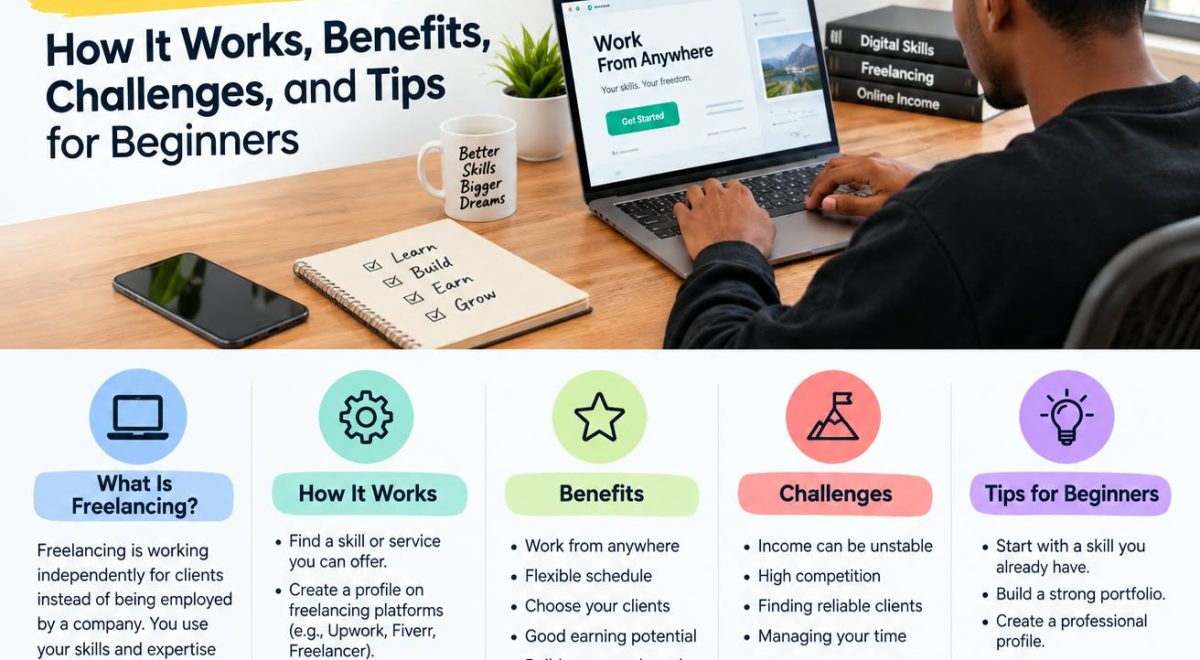
Freelancing is a flexible way of working in which a person provides services to clients without necessarily becoming a permanent employee of those clients. Freelancers can work independently, choose projects that match their skills, and often work with several clients over time.
But what is freelancing in practical terms? How do freelancers find clients, get paid, manage projects, and build a sustainable career?
This guide explains freelancing in simple terms, including how it works, common freelance jobs, its benefits and challenges, where beginners can find opportunities, and practical steps for getting started.
What Is Freelancing?
Freelancing is a form of independent work where an individual provides a specific service to a client or business, usually on a project, contract, or hourly basis.
Instead of working exclusively for one employer, a freelancer may work with multiple clients. The freelancer is generally responsible for finding work, agreeing on project requirements, completing assignments, communicating with clients, and managing payments and business expenses.
For example, a company might need a website logo. Instead of hiring a full-time graphic designer, it could hire a freelance designer to create the logo for a specific project.
Once the project is completed according to the agreed requirements, the freelancer receives payment based on the contract or agreement.
Simple Example of Freelancing
Imagine someone has strong writing skills.
They could offer services such as:
- Blog writing
- Website content
- Product descriptions
- Editing and proofreading
- Social media content
A business that needs blog articles could hire that person for individual articles or an ongoing contract.
The writer is responsible for completing the agreed work, while the client pays according to the agreed terms.
How Does Freelancing Work?
Although freelance arrangements vary, the basic process is usually straightforward.
1. Choose a Service
The freelancer identifies a skill that businesses or individuals may be willing to pay for.
Examples include:
- Graphic design
- Writing
- Web development
- Video editing
- Translation
- Virtual assistance
- Digital marketing
- Search engine optimization
- Programming
- Data entry
- Social media management
A freelancer does not necessarily need to offer many services. Starting with one clearly defined service can make it easier to explain what you provide.
2. Create a Professional Profile or Portfolio
Potential clients usually want to know what a freelancer can do before hiring them.
A portfolio can include examples of previous work, while a professional profile can explain:
- Your skills
- Services
- Experience
- Work samples
- Availability
- Relevant qualifications
Beginners who do not have paid client work can create sample projects to demonstrate their abilities, as long as they clearly identify them as sample or practice work.
3. Find Potential Clients
Freelancers can find clients through several channels.
These may include:
- Freelance marketplaces
- Professional networking platforms
- Personal websites
- Social media
- Referrals
- Direct outreach to businesses
- Existing professional contacts
Client-Finding Comparison
Freelancers can use different methods to find potential clients. Each method has different advantages and limitations, so the most suitable option depends on the freelancer’s service, experience, target clients, and preferred way of working.
| Client-Finding Method | Main Advantage | Main Limitation | Suitable For |
|---|---|---|---|
| Freelance marketplaces | Access to existing project opportunities | Competition can be high | Beginners looking for structured opportunities |
| Direct outreach | Allows you to target specific businesses | Requires research and communication | Freelancers with a clear target client |
| Referrals | Can build on existing relationships | Depends on your professional network | Freelancers with previous contacts |
| Professional networking | Helps develop long-term business relationships | Results may take time | Freelancers who want to build industry connections |
| Personal website | Gives you more control over your portfolio and presentation | You still need a way to attract visitors | Freelancers building a professional presence |
What This Comparison Shows
There is no single client-finding method that works the same way for every freelancer. A beginner can test one or two methods, track the results, and focus more on the approaches that fit their service and target clients.
My Practical Recommendation
Start with an approach that suits your current situation, even if you have limited experience.
4. Discuss the Project
Before beginning work, the freelancer and client should clarify the project.
Important details include:
- What needs to be delivered
- Project deadline
- Number of revisions
- Price or payment structure
- Communication method
- Ownership or usage rights where relevant
- Any additional requirements
Clear expectations can reduce misunderstandings later.
5. Complete and Deliver the Work
The freelancer completes the assignment according to the agreed requirements.
Professional freelancers communicate when necessary and notify clients if a legitimate issue could affect the deadline.
6. Receive Payment
Payment arrangements depend on the client, contract, platform, and location.
Some projects may be paid hourly, while others use a fixed project price or another agreed arrangement.
Freelancers should understand the payment terms before accepting a project.
Common Types of Freelance Work
Freelancing is not limited to one industry. Almost any skill that can be delivered independently may potentially become a freelance service.
Writing and Editing
Freelance writers can create:
- Blog posts
- Articles
- Website pages
- Newsletters
- Product descriptions
- Technical content
Editors and proofreaders help improve clarity, grammar, spelling, and consistency.
Graphic Design
Graphic designers may work on:
- Logos
- Social media graphics
- Presentations
- Marketing materials
- Website graphics
- Illustrations
Web Development
Web developers can build and maintain websites and web applications.
Common areas include:
- Front-end development
- Back-end development
- WordPress development
- E-commerce websites
- Website maintenance
Video Editing
Video editors may work with businesses, creators, organizations, and other clients to edit:
- YouTube videos
- Short-form videos
- Advertisements
- Educational videos
- Social media content
Digital Marketing
Freelance marketers may provide services such as:
- SEO
- Content marketing
- Social media management
- Email marketing
- Search advertising
- Marketing research
Virtual Assistance
Virtual assistants can help businesses with administrative tasks such as:
- Scheduling
- Email organization
- Data management
- Research
- Customer support
- Document preparation
Freelancing vs. Traditional Employment
Freelancing and traditional employment have important differences.
| Freelancing | Traditional Employment |
|---|---|
| Usually works independently | Usually works for an employer |
| May have multiple clients | Generally has one primary employer |
| Income can vary | Often has a regular salary or wage |
| Freelancer finds and manages projects | Employer generally assigns work |
| More control over projects | Employer typically determines responsibilities |
| May have flexible working arrangements | Usually follows employer policies and schedules |
| Responsible for business administration | Employer handles many employment-related responsibilities |
Neither model is automatically better for everyone.
Freelancing may suit people who value independence, while traditional employment may provide more predictable income and employer-provided benefits.
Benefits of Freelancing
Freelancing can provide several advantages, although the experience differs from person to person.
Flexible Work Arrangements
Many freelance jobs can be performed remotely, depending on the service and client.
This can give freelancers greater flexibility in deciding when and where they work.
However, flexibility does not mean that deadlines disappear. Clients still expect agreed work to be delivered on time.
Ability to Choose Projects
Freelancers can often decide which projects they want to pursue.
Over time, this may allow them to specialize in particular industries or services.
Opportunity to Build Different Skills
Working with different clients can expose freelancers to different industries, tools, communication styles, and business requirements.
This can help develop both technical and professional skills.
Potential for a Diverse Client Base
A freelancer may work with clients from different businesses, industries, or locations.
This can reduce dependence on a single client, although freelancers should still plan carefully for periods when projects are limited.
Building a Personal Business
Freelancing can be more than simply completing individual projects.
A freelancer can gradually develop:
- A professional reputation
- A portfolio
- Long-term client relationships
- A specialized service
- A personal website
- A recognizable professional brand
Challenges of Freelancing
Freelancing also has disadvantages that beginners should understand.
Income Can Be Unpredictable
Unlike a regular salary, freelance income can change from month to month.
Some periods may have several projects, while others may have fewer opportunities.
Building an emergency fund and maintaining a pipeline of potential clients can help manage this uncertainty.
Finding Clients Takes Work
Being skilled at a service does not automatically mean clients will find you.
Freelancers often need to spend time:
- Searching for opportunities
- Applying for projects
- Networking
- Improving their portfolio
- Communicating with potential clients
No Guaranteed Work
A client may stop a project, reduce its scope, or decide not to continue.
For this reason, freelancers should avoid depending entirely on one short-term project when possible.
Managing Everything Yourself
Freelancers often handle responsibilities beyond the actual service they provide.
These can include:
- Marketing
- Customer communication
- Scheduling
- Invoicing
- Record keeping
- Project management
- Business expenses
- Taxes and legal obligations
Tax and business requirements vary by country, so freelancers should check the rules that apply to their location.
Difficult Clients
Not every client relationship will be easy.
Problems can arise from unclear instructions, changing requirements, missed payments, or disagreements about revisions.
Written agreements and clear project requirements can help prevent many of these problems.
How to Start Freelancing as a Beginner
You do not need to offer every service available. A focused approach can make the beginning easier.
Step 1: Identify Your Strongest Skill
Start by considering what you can already do reasonably well.
For example, you might have experience with:
- Writing
- Design
- Technology
- Marketing
- Translation
- Administration
- Video editing
If your skill level is still developing, spend time practicing before accepting projects that require professional-level results.
Step 2: Choose a Specific Service
Instead of saying, “I can do everything,” create a clear service offer.
For example:
Too broad:
“I provide online services.”
More specific:
“I write SEO-friendly blog articles for small businesses.”
A specific offer helps potential clients understand what you actually provide.
Broad to Specific Examples
Choosing a service that is clear but not unnecessarily narrow can make it easier for potential clients to understand what you offer.
For example:
- Graphic Design → Social Media Graphic Design
- Writing → SEO Blog Writing
- Web Design → WordPress Websites for Small Businesses
- Video Editing → Short-Form Video Editing
These examples show how a broad skill can be turned into a more specific service that gives potential clients a clearer idea of what the freelancer can provide.
My Practical Recommendation:
Choose a service that is specific enough for clients to understand clearly, but broad enough that you can work on several related projects. As you gain experience, you can refine your service based on the type of work you enjoy, the projects you can deliver well, and the clients you want to serve.
Step 3: Build a Portfolio
Create several strong examples related to your chosen service.
If you want to become a web designer, for example, you could create sample websites.
If you want to become a writer, you could create sample articles covering different topics.
Quality is generally more useful than filling a portfolio with a large number of weak examples.
Step 4: Create Professional Profiles
Depending on your field, you may use freelance marketplaces, professional networks, or your own website.
Keep your profile:
- Accurate
- Clear
- Professional
- Focused on client needs
Do not claim qualifications, experience, or results that you do not actually have.
Step 5: Start Applying for Relevant Projects
Look for projects that match your current skills.
When responding to a client, avoid sending exactly the same generic message to everyone.
Instead, briefly explain:
- What you understand about the project.
- How your skills relate to it.
- What you can deliver.
- Any relevant examples from your portfolio.
Bad vs. Better Proposal Structure
A proposal should show the client that you understand their specific need rather than simply describing yourself.
Weak:
“Hello, I am an expert freelancer. I can do your project. Please hire me.”
Better Proposal Structure:
- Mention the client’s specific need.
- Explain your relevant skill.
- Briefly describe your approach.
- Add one relevant portfolio sample.
- Ask one useful question.
Proposal Checklist
Before sending a proposal, make sure you have:
- Addressed the client’s specific requirement
- Explained why your skill is relevant
- Briefly described your approach
- Included one relevant sample
- Asked a useful question
- Kept the proposal clear and concise
Step 6: Communicate Clearly
Good communication is an important part of freelance work.
Before starting, make sure you understand:
- The client’s goal
- Deliverables
- Deadline
- Budget
- Revision expectations
- File formats or technical requirements
Step 7: Deliver Reliable Work
Meeting deadlines and following the agreed requirements can help establish professional relationships.
If you encounter a problem, communicate early rather than waiting until the deadline has passed.
How Much Does a Freelancer Earn?
There is no single standard freelance income.
Earnings can vary considerably depending on factors such as:
- Skill level
- Industry
- Location
- Service offered
- Experience
- Client budget
- Number of projects
- Hours worked
- Pricing model
- Demand for the service
A beginner may charge differently from an experienced specialist.
It is also important to distinguish revenue from take-home income. Freelancers may have business expenses and tax obligations, depending on their circumstances.
Therefore, be cautious of websites or individuals promising a specific income simply for becoming a freelancer.
How Do Freelancers Set Their Prices?
Freelancers commonly use different pricing methods.
Hourly Pricing
The client pays for the amount of time spent working.
This can work well when the scope of a project may change or when ongoing support is required.
Fixed Project Pricing
The freelancer charges a specific amount for completing an agreed project.
This approach requires a clear understanding of what is included.
Retainer or Ongoing Agreements
A client may pay for an ongoing service over a defined period.
For example, a business could hire a freelancer to manage its social media content each month.
Whatever pricing model is used, the freelancer should clearly define what the client receives and what happens if the scope changes.
A Simple Pricing Checklist
Before setting a price, consider the full amount of work involved in the project:
Estimated work time + revisions + communication + tools or platform costs + project complexity
For example, a project that takes several hours to complete may require more than simply creating the final deliverable. The freelancer may also spend time on research, client communication, revisions, file preparation, and other project-related tasks.
Therefore, the price should reflect the overall work involved, not only the final output.
My Practical Recommendation:
Before agreeing to a price, clearly define what the project includes, how many revisions are covered, and what the client will receive. This can make the price easier to explain and help reduce misunderstandings.
Where Can Freelancers Find Work?
Freelance opportunities can come from several sources.
Freelance Platforms
Freelance marketplaces connect clients with independent professionals.
The available services, fees, payment methods, eligibility requirements, and rules vary by platform.
Always check the platform’s current official policies before relying on it for work.
Personal Website
A personal website can act as a professional portfolio.
It can contain:
- About page
- Services
- Portfolio
- Contact information
- Client process
- Relevant professional information
Professional Networking
Networking can help freelancers discover opportunities through people and businesses they already know.
Professional relationships can become valuable sources of referrals over time.
Direct Business Outreach
A freelancer may contact businesses that could reasonably benefit from their services.
The communication should be relevant and professional rather than sending large volumes of unwanted messages.
Freelancing Tips for Beginners
Keep Learning
Freelance markets change over time.
Continue developing your technical skills, communication abilities, and knowledge of the tools used in your industry.
Protect Your Time
Do not accept every project simply because it is available.
Consider whether the project fits your skills, schedule, pricing, and professional goals.
Use Written Agreements
Important project details should be documented.
A written agreement can clarify responsibilities, payment terms, deadlines, revisions, and ownership rights.
For significant contracts, consider getting appropriate legal advice in your jurisdiction.
Keep Business Records
Maintain records of:
- Payments
- Expenses
- Contracts
- Invoices
- Project details
Good records can make business administration easier and may be important for tax purposes.
Watch for Suspicious Opportunities
Be cautious when a supposed client asks you to:
- Pay an unexplained fee before receiving work
- Provide unnecessary sensitive information
- Move payments through questionable methods
- Perform work far beyond the agreed scope without additional compensation
If something seems unusual, verify the client and the agreement before proceeding.
Build Long-Term Relationships
A satisfied client may return for additional work or recommend your services to others.
Focus on delivering the agreed service professionally rather than trying to maximize every individual transaction.
Common Freelancing Mistakes to Avoid
Beginners often make avoidable mistakes when starting out.
Accepting Work Without Understanding the Requirements
Never begin an important project if you are unsure what the client expects.
Ask questions before agreeing to the work.
Charging Without Considering the Full Workload
A project that looks simple may require research, meetings, revisions, administration, and communication.
Consider the complete workload when deciding whether a price is reasonable.
Relying on One Client
One large client can be valuable, but depending entirely on one source of income can create risk if the relationship ends.
Ignoring Professional Communication
Slow or unclear communication can cause unnecessary problems.
Keep clients updated when important information changes.
Promising What You Cannot Deliver
It is better to be honest about your abilities than to accept work that you cannot complete to the required standard.
Is Freelancing a Good Career Choice?
Freelancing can be a good career option for people who enjoy independent work and are prepared to manage both client projects and business responsibilities.
It may offer flexibility and variety, but it also requires self-discipline, financial planning, communication, and continuous learning.
The right choice depends on your skills, goals, financial situation, preferred working style, and tolerance for income variability.
Frequently Asked Questions About Freelancing
What is freelancing in simple words?
Freelancing means working independently for clients rather than being permanently employed by one employer. A freelancer provides specific services and is typically paid according to an agreed project, hourly rate, or contract.
Can a beginner start freelancing?
Yes. Beginners can start by developing a useful skill, creating a portfolio, choosing a specific service, and looking for projects that match their abilities. It is important to start with realistic expectations and continue improving.
Do freelancers work from home?
Many freelancers work from home because numerous services can be delivered online. However, freelancers can also work from offices, coworking spaces, client locations, or other suitable environments depending on their profession.
Is freelance income guaranteed?
No. Freelance income is not guaranteed. The amount a freelancer earns can change depending on clients, projects, skills, demand, pricing, and other factors.
What skills are best for freelancing?
There is no single best freelance skill. Useful areas include writing, graphic design, programming, web development, video editing, digital marketing, translation, virtual assistance, and many other professional services. The best choice depends on your abilities and the demand for your chosen service.
Conclusion
Freelancing is a form of independent work that allows people to provide professional services directly to clients. What is freelancing ultimately comes down to a simple idea: you use your skills to complete work for clients under agreed terms rather than working exclusively as a permanent employee.
The benefits can include flexible working arrangements, project variety, and the opportunity to build an independent professional career. At the same time, freelancers must deal with challenges such as inconsistent income, finding clients, managing deadlines, and handling business responsibilities.
For beginners, the best starting point is to develop a useful skill, choose a clear service, build a strong portfolio, communicate professionally, and approach freelancing as a real business rather than a promise of quick income.
With realistic expectations and consistent effort, freelancing can become a practical way to offer your skills to clients and develop a long-term professional career.