


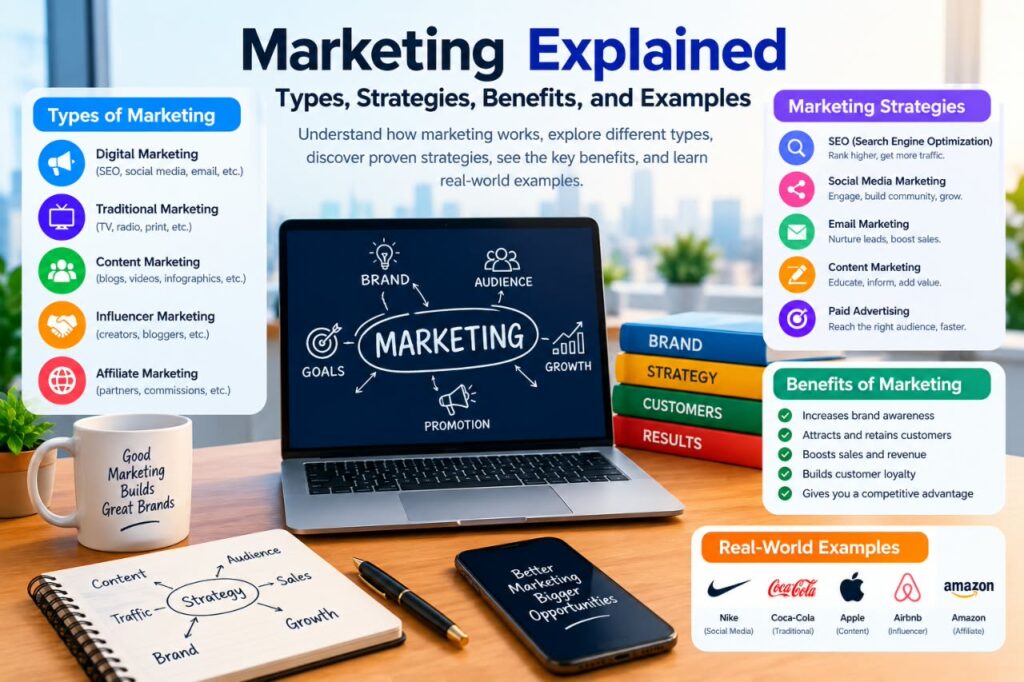
Introduction
Marketing is one of the most important activities for businesses, organizations, and entrepreneurs. It helps people discover products and services, understand their value, and decide whether they are suitable for their needs.
But marketing is much more than advertising.
Marketing explained simply is the process of understanding a target audience, creating an appropriate offer, communicating its value, and making it available through suitable channels. Depending on the business, marketing can include research, branding, content creation, social media, email, search engines, advertising, public relations, and many other activities.
This guide explains the fundamentals of marketing, including its major types, common strategies, benefits, limitations, and practical examples.
What Is Marketing?
Marketing is the process of identifying customer needs and communicating the value of a product, service, or brand to a relevant audience.
It involves several connected activities, such as:
- Understanding the target market
- Researching customer needs
- Developing products or services
- Creating a brand identity
- Setting appropriate prices
- Promoting products or services
- Choosing distribution channels
- Building relationships with customers
- Measuring marketing performance
For example, imagine a small business that sells handmade notebooks.
The business might research what types of notebooks customers prefer, create products based on that information, build a recognizable brand, promote the notebooks through social media and search engines, and sell them through an online store.
All of these activities can be part of marketing.
How Does Marketing Work?
Marketing generally starts with understanding who the customer is and what they need.
A basic marketing process can look like this:
1. Identify the Target Audience
A business first needs to understand who is most likely to benefit from its product or service.
Relevant characteristics may include:
- Age range
- Location
- Interests
- Occupation
- Buying behavior
- Problems or needs
- Budget
- Preferences
A clear target audience helps a business create more relevant marketing messages.
2. Understand Customer Needs
Knowing the audience is not enough. A business also needs to understand the problem it is trying to solve.
For example, a company selling project-management software might focus on businesses that need better ways to organize tasks, deadlines, and team communication.
3. Create a Valuable Offer
The product or service should provide something useful to the intended customer.
Marketing cannot compensate indefinitely for an unsuitable product or poor customer experience. A strong marketing strategy should therefore work alongside a useful product or service.
4. Communicate the Value
Businesses then explain what they offer and why it may be useful.
Communication can happen through:
- Websites
- Blog posts
- Social media
- Search engines
- Videos
- Advertising
- Events
- Public relations
5. Make the Offer Accessible
Customers need a convenient way to learn more, contact the business, or purchase the product.
This may involve an online store, physical location, booking system, sales team, or another appropriate channel.
6. Measure and Improve
Marketing should not simply stop after a campaign is published.
Businesses can evaluate results and identify what worked, what did not, and what should be improved.
Major Types of Marketing
There is no single type of marketing that works for every business. Companies often combine several approaches depending on their audience, goals, industry, and budget.
1. Digital Marketing
Digital marketing uses internet-connected channels to communicate with potential and existing customers.
Common examples include:
- Search engine optimization
- Social media marketing
- Email marketing
- Content marketing
- Online advertising
- Video marketing
Digital marketing can be particularly useful for businesses that want to reach people through online channels.
2. Content Marketing
Content marketing focuses on creating and distributing useful, relevant content for a specific audience.
Examples include:
- Blog articles
- Guides
- Tutorials
- Videos
- Infographics
- Newsletters
- Educational resources
For example, a company selling gardening equipment could publish articles explaining how to choose gardening tools and maintain them.
The goal is to provide useful information while building awareness and trust around the brand.
3. Search Engine Optimization (SEO)
SEO involves improving online content and websites so that they can be better understood by search engines and users.
SEO can involve:
- Creating useful content
- Improving website structure
- Using descriptive page titles
- Improving internal linking
- Making websites easier to navigate
- Addressing technical issues
- Understanding search intent
SEO is generally a long-term approach rather than a guarantee of immediate traffic or rankings.
4. Social Media Marketing
Social media marketing uses platforms such as social networks and video-sharing services to communicate with an audience.
Businesses may use social media to:
- Share educational content
- Introduce products
- Answer questions
- Build communities
- Announce updates
- Encourage customer engagement
Different platforms attract different audiences, so businesses should select channels based on where their intended customers actually spend time.
5. Email Marketing
Email marketing involves communicating with people through email, usually with permission.
Common uses include:
- Newsletters
- Product updates
- Educational content
- Special offers
- Customer onboarding
- Event announcements
Effective email marketing should provide useful information and respect subscribers’ preferences.
6. Influencer Marketing
Influencer marketing involves collaborating with people who have an established audience and influence within a particular area.
For example, a fitness equipment company might collaborate with a fitness content creator whose audience is interested in exercise equipment.
The suitability of the partnership matters more than simply choosing someone with a large audience.
7. Affiliate Marketing
Affiliate marketing is a performance-based approach in which affiliates promote products or services and may receive a commission when qualifying actions occur according to a program’s terms.
For example, a website could publish a useful comparison of several software products and provide affiliate links where appropriate.
Affiliate content should clearly explain the products and avoid misleading claims.
8. Traditional Marketing
Traditional marketing uses offline channels.
Examples include:
- Print advertising
- Radio
- Television
- Billboards
- Direct mail
- Brochures
- Events
Although digital marketing is important, offline marketing can still be appropriate depending on the audience and industry.
9. Relationship Marketing
Relationship marketing focuses on building long-term relationships with customers rather than concentrating only on individual transactions.
Businesses may use:
- Customer support
- Loyalty programs
- Personalized communication
- Follow-up messages
- Helpful educational resources
The objective is to create a positive customer experience and encourage long-term engagement.
Common Marketing Strategies
Marketing types describe where or how marketing happens, while strategies describe the approach used to achieve a particular objective.
Define a Clear Target Market
One of the first steps is deciding who the business wants to reach.
Trying to communicate with everyone can make marketing messages too general.
A clearly defined audience allows businesses to create more relevant content, offers, and communication.
Build a Strong Brand
A brand is more than a logo.
It can include:
- Name
- Visual identity
- Tone of communication
- Customer experience
- Reputation
- Values
- Positioning
A consistent brand can make a business easier for customers to recognize and understand.
Use a Content Strategy
A content strategy determines what information a business creates, who it is for, and how it supports broader business goals.
For example, a website selling accounting software could create content around:
- Basic accounting concepts
- Small-business bookkeeping
- Invoicing
- Financial organization
- Software tutorials
The content should answer genuine questions rather than simply repeat keywords.
Use Search Marketing
Search marketing can help businesses reach people who are actively looking for information, products, or services.
SEO focuses on organic search visibility, while paid search advertising involves paying for advertising placements.
Both approaches can be useful, but they operate differently and should be evaluated separately.
Use Social Media Strategically
Instead of publishing content on every available platform, businesses can focus on the channels most relevant to their audience.
A practical social media strategy might include:
- Choosing relevant platforms
- Defining content themes
- Creating a publishing schedule
- Responding to audience questions
- Reviewing performance
- Adjusting the strategy
Measure Marketing Performance
Businesses need appropriate metrics to understand whether their activities are producing useful results.
Depending on the goal, measurements may include:
- Website visits
- Leads
- Conversion rate
- Sales
- Email engagement
- Customer retention
- Cost per acquisition
- Return on advertising spend
A metric is only useful when it relates to a meaningful business objective.
The 4 Ps of Marketing
A traditional framework for understanding marketing is the 4 Ps:
Product
What is being offered to customers?
This includes the product’s features, quality, design, packaging, and usefulness.
Price
How much does the customer pay?
Pricing can influence how customers perceive an offer and whether it fits their budget.
Place
Where and how is the product or service made available?
This could include physical stores, websites, marketplaces, distributors, or other channels.
Promotion
How does the business communicate with potential customers?
Promotion can include advertising, public relations, content, email, social media, and other communication methods.
The 4 Ps provide a useful framework, although modern marketing can involve many additional factors, particularly for services and digital businesses.
Benefits of Marketing
Effective marketing can provide several benefits to a business.
Increased Awareness
Marketing helps potential customers discover a business, product, or service.
A good product may struggle to reach its intended audience if people do not know it exists.
Better Understanding of Customers
Marketing research can help businesses learn about customer needs, preferences, questions, and concerns.
This information can also influence product development and customer service.
More Relevant Communication
Understanding the target audience allows businesses to create messages that are more relevant to the people they want to reach.
Stronger Brand Recognition
Consistent marketing can help customers become familiar with a company’s name, products, and overall identity.
Customer Relationships
Marketing can support ongoing communication with existing customers, not just potential buyers.
Business Growth
Marketing can contribute to growth by helping businesses attract customers and communicate the value of their offerings.
However, marketing alone does not guarantee sales or business success. Results depend on many factors, including the quality of the product, market demand, competition, pricing, customer experience, and execution.
Limitations and Challenges of Marketing
Marketing can be valuable, but it also has challenges.
Competition
Businesses often compete for the attention of the same audience.
Costs
Some marketing activities require spending on tools, advertising, employees, agencies, content production, or technology.
Changing Customer Behavior
Customer preferences and online behavior can change over time.
Measurement Difficulties
It is not always easy to determine exactly which marketing activity influenced a customer’s decision.
Long-Term Effort
Some approaches, particularly content marketing and SEO, may require consistent effort before meaningful results become visible.
Risk of Poor Targeting
Marketing the right product to the wrong audience can waste resources and produce weak results.
Marketing Examples
Understanding marketing through examples can make the concepts easier to apply.
Example 1: Local Restaurant
A local restaurant could use marketing by:
- Creating a website
- Optimizing its business information for local search
- Posting food photographs on social media
- Publishing its menu online
- Collecting customer feedback
- Sending updates to customers who have opted in
These activities support awareness and customer communication.
Example 2: Online Education Website
An educational website could publish free tutorials related to its courses.
For example, it might create articles about beginner-level digital skills and then explain how its paid courses provide more comprehensive learning resources.
The free content provides value while introducing readers to the brand.
Example 3: Clothing Business
A clothing company could combine:
- Social media marketing
- Influencer partnerships
- Email marketing
- Search optimization
- Product photography
- Seasonal campaigns
The company could then analyze which channels attract relevant visitors and customers.
How to Create a Simple Marketing Strategy
If you are starting from scratch, you do not need to use every marketing channel immediately.
Follow a simple process.
Step 1: Set a Specific Goal
Decide what you want marketing to accomplish.
For example:
- Increase brand awareness
- Generate qualified leads
- Increase online sales
- Attract local customers
- Grow an email audience
Step 2: Define Your Audience
Describe the people most likely to benefit from your product or service.
Step 3: Identify Their Problems
Find out what questions, needs, or challenges your audience has.
Step 4: Choose Suitable Channels
Select channels based on your audience and resources.
A small business might begin with a website, local search presence, and one social media platform rather than attempting to manage every channel.
Step 5: Create Useful Content
Produce information that genuinely helps your audience.
Useful content can answer questions, explain products, solve problems, or help people make informed decisions.
Step 6: Track Results
Monitor relevant performance indicators.
Avoid focusing only on surface-level numbers. For example, a large amount of website traffic is not necessarily valuable if the visitors are not relevant to the business.
Step 7: Improve Over Time
Marketing is an ongoing process.
Use what you learn from customers and performance data to improve your messaging, content, products, and campaigns.
Marketing vs. Advertising: What Is the Difference?
Marketing and advertising are related, but they are not identical.
Marketing is the broader process of understanding customers, developing an offer, positioning it, communicating its value, distributing it, and building relationships.
Advertising is one promotional method within marketing that typically involves paying to place messages in front of an audience.
For example, a business might use marketing research to understand its audience, develop a product, create a website, publish educational content, and then use paid advertising to promote that product.
Advertising is therefore one part of a larger marketing system.
Digital Marketing vs. Traditional Marketing
| Feature | Digital Marketing | Traditional Marketing |
| Main channels | Websites, search, email, social media | TV, radio, print, billboards |
| Audience targeting | Often highly specific | Can be broader |
| Measurement | Often provides detailed digital data | Measurement can vary by channel |
| Communication | Can be interactive | Often one-way |
| Geographic reach | Can be local or global | Often depends on the medium |
| Typical strengths | Flexibility and online reach | Local presence and broad offline exposure |
Neither approach is automatically better for every business. The appropriate choice depends on the target audience, objectives, industry, budget, and available resources.
Tips for More Effective Marketing
Focus on the Customer
Start with the customer’s needs rather than simply talking about the business.
Be Clear
Explain what you offer and who it is intended for.
Provide Genuine Value
Educational and useful content can be more valuable than content created only to promote a product.
Keep Your Brand Consistent
Use consistent messaging and visual identity across important channels.
Test Carefully
When possible, test different approaches and compare meaningful results.
Respect Your Audience
Avoid misleading claims, excessive messaging, deceptive practices, or communication people did not request.
Keep Learning
Marketing channels and customer expectations change. Businesses should review current platform rules, advertising requirements, privacy obligations, and other applicable regulations when making decisions.
Frequently Asked Questions About Marketing
What is marketing in simple words?
Marketing is the process of understanding customers, communicating the value of a product or service, and making that offering available to the people who may need it.
What are the main types of marketing?
Common types include digital marketing, content marketing, SEO, social media marketing, email marketing, influencer marketing, affiliate marketing, traditional marketing, and relationship marketing.
What are the 4 Ps of marketing?
The 4 Ps are Product, Price, Place, and Promotion. They provide a basic framework for thinking about an offering and how it reaches customers.
Is marketing the same as advertising?
No. Advertising is one part of marketing. Marketing covers a much broader range of activities, including research, branding, product positioning, distribution, content, customer relationships, and promotion.
Why is marketing important for a business?
Marketing helps businesses understand their audiences, communicate their offerings, build awareness, develop customer relationships, and support business objectives. However, marketing does not guarantee sales or success.
Conclusion
Marketing explained in simple terms is the process of connecting a useful product or service with the people who may benefit from it. It involves much more than advertisements and promotional messages.
Successful marketing can include customer research, branding, content creation, SEO, social media, email, advertising, distribution, and relationship building. The best approach depends on the business, audience, objectives, resources, and market.
For beginners, the most practical starting point is to understand the audience, define a clear goal, choose a few relevant channels, provide useful information, measure meaningful results, and improve consistently.
Marketing works best when it focuses on creating genuine value for customers rather than simply trying to attract attention.