
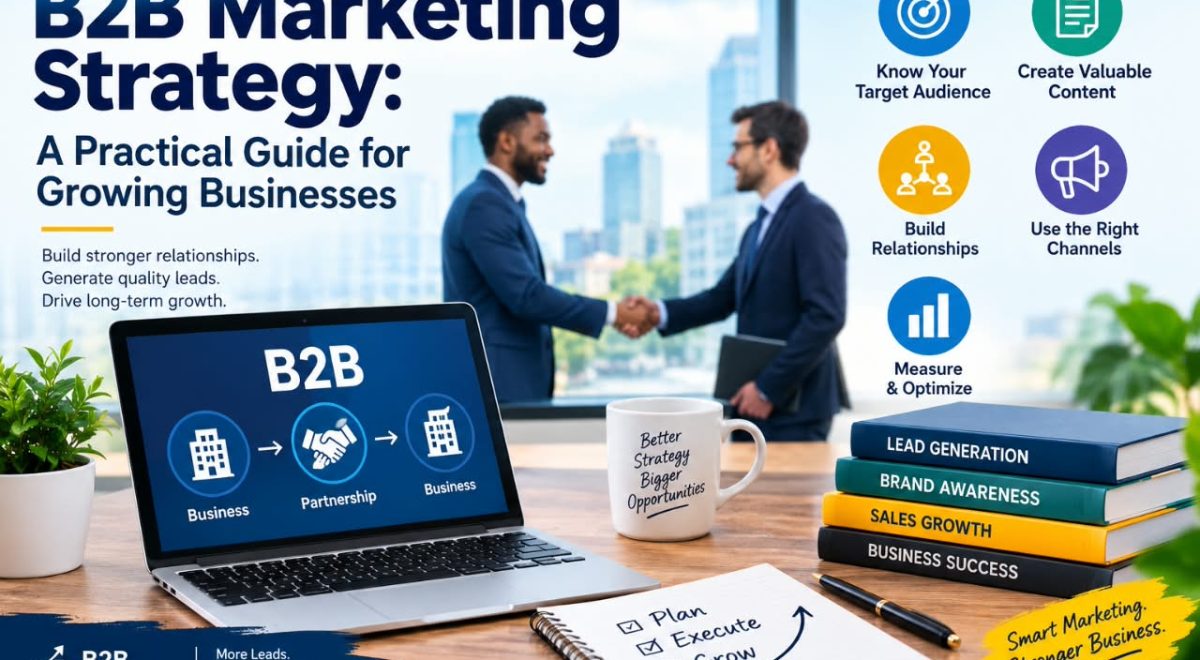
A B2B marketing strategy is a structured approach to reaching, educating, and converting other businesses into customers. Unlike consumer marketing, B2B marketing often involves longer decision-making processes, multiple stakeholders, specialized products or services, and a greater need for useful information before a purchase.
A good strategy does not require using every available marketing channel. The goal is to understand the target business audience, identify their needs, choose appropriate channels, create useful content, and measure whether those activities are contributing to meaningful business objectives.
For a small company, this can sound complicated. However, a B2B marketing strategy can be built step by step by starting with the customer, defining a clear offer, selecting suitable channels, and improving the approach based on actual results.
What Is a B2B Marketing Strategy?
A B2B marketing strategy is a structured approach to reaching, educating, and converting other businesses into customers. Unlike consumer marketing, B2B marketing often involves longer decision-making processes, multiple stakeholders, specialized products or services, and a greater need for useful information before a purchase.
A good strategy does not require using every available marketing channel. The goal is to understand the target business audience, identify their needs, choose appropriate channels, create useful content, and measure whether those activities are contributing to meaningful business objectives.
A Simple B2B Marketing Strategy Framework
A practical way to build a B2B marketing strategy is to follow five connected stages: Research → Select → Create → Measure → Improve.
Research: Identify the target audience, their needs, common problems, and buying considerations.
Select: Choose the most relevant marketing channels, content types, and priorities based on the audience and business objective.
Create: Develop useful content, resources, or offers that address the needs identified during the research stage.
Measure: Review relevant performance indicators to understand which activities are producing useful results.
Improve: Use performance data and customer feedback to refine the strategy, improve weak areas, and adjust priorities.
This framework provides a simple way to connect different marketing activities instead of treating SEO, content, email, social media, and advertising as completely separate efforts.
For example, a software company might first research the needs of small business teams, select SEO and educational content as initial channels, create practical guides around those needs, measure traffic and qualified inquiries, and then improve its content based on the results..
Why a B2B Marketing Strategy Matters
Without a clear strategy, businesses can easily spend time creating content or running campaigns without knowing how those activities connect to their objectives.
A structured approach helps connect individual marketing activities.
For example:
Audience research → useful content → qualified visitors → lead capture → sales follow-up → customer
This does not mean every prospect follows the same path. B2B buying journeys can involve different channels, people, and stages. The framework simply helps a business understand how its marketing activities fit together.
A strategy can also help prevent common problems such as:
- Targeting an overly broad audience
- Publishing content without a clear purpose
- Choosing channels because they are popular rather than relevant
- Measuring traffic while ignoring lead quality
- Focusing on short-term promotion without building useful resources
Key Elements of a B2B Marketing Strategy
A practical strategy usually combines several connected elements rather than relying on one marketing tactic.
1. Define the Target Audience
The first step is understanding who the business is trying to reach.
Instead of describing the audience simply as “business owners,” create a more useful customer profile.
Consider factors such as:
- Industry
- Company size
- Business model
- Geographic market
- Job role
- Common challenges
- Purchasing responsibilities
- Existing solutions
- Budget considerations
- Buying triggers
For example, a company selling project-management software might focus on small technology companies with distributed teams rather than trying to reach every business.
A narrower audience can make messaging and content more relevant.
2. Identify Customer Problems
B2B buyers generally need a reason to investigate a product or service.
Research the problems that your target customers are already trying to solve.
Useful sources of insight can include:
- Customer conversations
- Sales-team feedback
- Product support questions
- Search behavior
- Competitor reviews
- Industry discussions
- Existing customer feedback
- Frequently asked questions
The purpose is not to invent customer problems. It is to identify recurring needs that can be addressed through useful information or solutions.
3. Define the Value Proposition
A value proposition explains why a potential customer should consider a company’s offering.
A useful value proposition should make clear:
Who is the product for?
What problem does it address?
How does the solution work?
What makes the offering relevant compared with available alternatives?
For example, instead of saying:
“Our software is the best business platform.”
A clearer description might explain the type of business it serves, the problem it addresses, and the main capabilities it provides.
Specific information is generally more useful than broad promotional language.
Quick B2B Strategy Checklist
Before launching a B2B marketing campaign, make sure you can answer these questions:
- Who exactly are we trying to reach?
- What problem are they trying to solve?
- Why would they consider our solution?
- Which marketing channels are most relevant to them?
- What action should a potential customer take next?
- How will we measure whether the activity is useful?
Practical Example
Imagine a company that provides project-management software for small and medium-sized businesses with distributed teams. The checklist could be applied like this:
| Question | Example Answer |
| Who are we trying to reach? | Small and medium-sized businesses with distributed teams |
| What problem are they trying to solve? | Keeping projects, tasks, and team communication organized |
| Why would they consider our solution? | It provides tools for project management and team collaboration |
| Which channels are relevant? | SEO, educational content, email, and product demonstrations |
| What should the customer do next? | Read a product guide or request a demonstration |
| How will we measure results? | Relevant website visits, qualified inquiries, and completed demonstrations |
This example shows how a general checklist can be turned into a practical marketing plan. Instead of using every available channel, the company can focus on the audience, problem, relevant channels, next action, and measurements that fit its business objectives.
Choosing B2B Marketing Channels
There is no single marketing channel that works for every B2B company.
The right combination depends on where the target audience researches products, how complicated the purchase is, and how the company communicates with potential customers.
Search Engine Optimization
SEO can help businesses make useful pages discoverable when potential customers search for relevant information.
B2B SEO content may include:
- Educational guides
- Product comparisons
- Industry explanations
- Software tutorials
- Problem-solving articles
- Service pages
- Frequently asked questions
The strongest opportunities are usually connected to genuine customer questions rather than keywords selected only because they have search volume.
For example, a cybersecurity company could create content explaining how businesses can evaluate password-management solutions rather than publishing generic articles about “technology.”
SEO can take time, and rankings are not guaranteed. Search performance also depends on competition, content quality, website structure, and other factors.
Content Marketing
Content marketing involves creating useful material for a defined audience.
B2B content can include:
- Blog articles
- White papers
- Case studies
- Guides
- Webinars
- Videos
- Templates
- Product documentation
- Research summaries
Different formats serve different purposes.
An introductory article may help someone understand a problem, while a comparison guide may help someone evaluate potential solutions.
The important point is to match the content with the reader’s stage in the buying process.
Email Marketing
Email can be useful for maintaining communication with people who have voluntarily provided their contact information.
For example, a company might use email to send:
- Educational resources
- Product updates
- New articles
- Event information
- Relevant offers
- Follow-up information
Effective B2B email marketing should be relevant and respectful. Sending excessive or unrelated messages can reduce trust and engagement.
Social Media Marketing
Social platforms can support B2B marketing by helping businesses distribute content, communicate with professional audiences, and develop awareness.
However, businesses should not automatically use every social platform.
The better question is:
Where does the target audience actually spend time and interact with relevant information?
A company targeting professionals may have different opportunities from a company targeting creative freelancers or local businesses.
Paid Advertising
Paid search, display advertising, social advertising, and other paid channels can provide another way to reach potential customers.
Before spending money, define:
- Target audience
- Campaign objective
- Landing page
- Budget
- Conversion action
- Measurement method
Paid advertising can generate visibility quickly, but spending money does not automatically produce qualified customers. Campaign performance needs to be monitored and adjusted.
How to Choose the Right B2B Marketing Channel
Choosing a marketing channel should be based on more than popularity. A practical approach is to evaluate each channel against three factors: audience fit, business objective, and available resources.
First, consider whether the target audience actually uses or responds to the channel. Next, identify what the business wants the channel to accomplish. Finally, consider whether the company has enough time, skills, and budget to manage the channel consistently.
For example, SEO may be appropriate when potential customers regularly search for educational information. Email marketing may be useful when a business has permission-based contacts and wants to maintain communication with them. Paid advertising can be used to test specific offers, but it requires a defined budget and a clear measurement process.
The following framework can help businesses connect their goals with potentially relevant marketing approaches:
| If your goal is… | Consider… | Why |
| Build organic visibility | SEO + Content | Helps answer search-based questions |
| Educate prospects | Guides + Webinars | Provides more detailed information |
| Nurture existing leads | Email + Content | Supports ongoing communication |
| Test a specific offer | Paid Advertising | Allows controlled campaign testing |
| Explain a complex product | Demos + Guides | Gives prospects more detailed information |
This comparison does not mean that one channel is automatically better than another. The appropriate choice depends on the target audience, business objective, available resources, and complexity of the product or service.
A business can also combine channels. For example, an educational article may attract a potential customer through search, an email resource may support further engagement, and a product demonstration may provide additional information during the evaluation stage.
Comparing Common B2B Marketing Approaches
Different approaches have different strengths and limitations.
| Approach | Useful For | Main Consideration |
| SEO | Long-term organic discovery | Results can take time |
| Content marketing | Education and trust-building | Requires consistent quality |
| Email marketing | Nurturing known prospects | Requires permission and relevant content |
| Social media | Distribution and engagement | Results vary by audience and platform |
| Paid advertising | Targeted reach and testing | Requires ongoing budget |
| Webinars | Education and direct interaction | Requires planning and promotion |
| Case studies | Demonstrating real customer applications | Must be accurate and properly supported |
These approaches are not necessarily competitors. A company can combine several of them.
For example, an educational article may attract an organic visitor, an email subscription may maintain the relationship, and a product demonstration may help the prospect evaluate the solution.
What the Comparison Shows
The comparison shows that different B2B marketing approaches can serve different purposes. SEO and content marketing can help businesses reach people who are researching relevant topics, while email marketing can support ongoing communication with existing contacts. Paid advertising can be useful for testing specific campaigns or offers, while webinars and demonstrations can provide more detailed information about complex products or services.
Rather than choosing a channel simply because it is popular, businesses should consider how well it fits their audience, objective, resources, and buying process. In some cases, combining several channels may provide a more practical approach. For example, SEO can help attract relevant visitors, educational content can answer their questions, and email or a product demonstration can support further evaluation.
The comparison is therefore a planning tool rather than a ranking of marketing channels. The most appropriate combination depends on the specific business and the customers it is trying to reach.
How to Build a B2B Marketing Strategy Step by Step
Step 1: Define a Specific Business Objective
Start with an objective rather than a marketing channel.
Possible objectives include:
- Increasing qualified leads
- Expanding awareness in a specific industry
- Supporting a new product launch
- Increasing requests for demonstrations
- Building an email audience
- Improving organic search visibility
A clear objective makes it easier to decide what activities are worth pursuing.
Step 2: Research the Audience
Collect information about the companies and people you want to reach.
Look for:
- Their common problems
- Questions they ask
- Existing solutions
- Buying concerns
- Important features
- Budget considerations
- Decision-making roles
Avoid assuming that every company in an industry has the same needs.
Step 3: Map the Buying Journey
Consider what information a potential customer needs at different stages.
Awareness:
The person is identifying or learning about a problem.
Consideration:
The person is researching possible approaches or solutions.
Evaluation:
The person is comparing specific products or providers.
Decision:
The organization is deciding whether and how to purchase.
Retention:
The customer needs support, education, or additional solutions.
Content and communication should reflect these different needs.
Step 4: Choose the Most Relevant Channels
Select channels based on your audience and objectives.
For example:
Goal: Build organic discovery
Possible channels: SEO and content marketing
Goal: Nurture existing leads
Possible channels: Email and educational content
Goal: Reach a defined audience quickly
Possible channels: Paid advertising
Goal: Explain a complicated product
Possible channels: Webinars, demonstrations, guides, and sales content
The strategy should explain why a channel is being used instead of simply listing channels.
Step 5: Create a Content Plan
Build content around real customer questions.
A simple content plan might include:
- Educational article
- Detailed guide
- Comparison article
- Practical checklist
- Product-related resource
- Case study
- FAQ content
Connect related content through internal links so readers can move from introductory information to more detailed resources.
Step 6: Create Useful Calls to Action
A call to action tells the reader what they can do next.
Examples include:
- Download a guide
- Request a demonstration
- Contact the company
- Read a related guide
- Subscribe to an email newsletter
- Explore product documentation
The CTA should be appropriate for the reader’s stage.
Someone reading an introductory educational article may not be ready for a sales consultation, while someone comparing specific solutions may want pricing or a demonstration.
Step 7: Measure and Improve
Review the results of your marketing activities regularly.
Depending on the strategy, useful measurements can include:
- Organic traffic
- Qualified leads
- Conversion rates
- Email engagement
- Landing-page performance
- Cost per lead
- Lead-to-customer conversion
- Customer acquisition cost
- Revenue attributed to marketing activities
No single metric explains the entire performance of a B2B marketing strategy.
For example, high website traffic does not necessarily mean the visitors are relevant prospects.
Example: A Small B2B Software Company
Imagine a small software company that provides project-management tools for growing teams. Instead of targeting every business, it could focus on companies with distributed teams that need better project coordination.
Its strategy could begin with educational content about project organization, followed by comparison pages and product guides. Visitors who want more information could be offered a product demonstration or an email resource.
The company could then measure which content attracts relevant visitors, which pages generate engagement, and which activities contribute to qualified inquiries. Based on these results, it could improve its content, adjust its marketing channels, and focus more resources on activities that support its business goals.
This example shows how the steps in a B2B marketing strategy can work together. The company identifies a specific audience, understands its needs, creates relevant content, chooses suitable channels, and measures the results to guide future improvements.
Common B2B Marketing Mistakes
Targeting Everyone
Trying to market to every business can produce vague messaging.
A more specific audience can make it easier to create relevant content and communicate the value of a product.
Publishing Without a Purpose
A large number of articles does not automatically create a strong content strategy.
Each piece should have a clear purpose and address a meaningful audience need.
Focusing Only on Short-Term Leads
Lead generation matters, but B2B purchases can involve longer decision processes.
Educational content, useful follow-up, and clear product information can support prospects who are not ready to buy immediately.
Using Too Many Channels
Managing five channels poorly may be less useful than managing two or three channels carefully.
Start with channels that fit the audience and resources available.
Measuring the Wrong Things
Traffic, impressions, clicks, and followers can provide useful information, but they do not necessarily represent business outcomes.
Connect marketing measurements to the actual objective of the strategy.
How to Avoid These Mistakes
A useful way to avoid these mistakes is to review the marketing strategy before increasing activity. More content, more channels, or more advertising is not necessarily better. Businesses should first identify what is relevant to their audience and what can realistically be managed with their available resources.
Before launching or expanding a campaign, review the target audience, marketing objectives, selected channels, content plan, and measurement process. This review can help identify activities that are unnecessary, difficult to manage, or not closely connected to the business goal.
For example, a small B2B company may choose to focus on two relevant marketing channels rather than trying to maintain several platforms at the same time. It can then measure the results, learn from customer responses, and adjust its strategy based on what it discovers.
The appropriate approach depends on the company’s audience, resources, product or service, and marketing objectives. A focused and manageable strategy can make it easier to maintain consistent marketing activities and improve them over time.
How Small Businesses Can Approach B2B Marketing
Smaller businesses often have limited budgets and teams.
That makes prioritization important.
A practical approach can be:
1. Choose a narrow audience.
Focus on a group whose needs you understand.
2. Identify recurring questions.
Use customer conversations, search research, and support questions.
3. Create genuinely useful resources.
Build content that answers those questions clearly.
4. Select a small number of channels.
Choose channels that match your audience and available resources.
5. Track meaningful results.
Measure leads and business outcomes rather than relying only on visibility metrics.
6. Improve gradually.
Use actual performance and customer feedback to refine the strategy.
This approach can help prevent a small marketing team from spreading its resources too thinly.
B2B Marketing Strategy vs. B2C Marketing Strategy
B2B and B2C marketing can use many of the same channels, but their buying environments can differ.
| Factor | B2B | B2C |
| Buyer | Business or professional buyer | Individual consumer |
| Decision process | Often involves multiple considerations or stakeholders | Can be simpler for many purchases |
| Purchase value | Can range from low-cost tools to large contracts | Varies widely |
| Content needs | Often detailed and problem-focused | Often combines information with consumer-oriented messaging |
| Sales cycle | Can be longer depending on the product | Can be shorter for many consumer purchases |
| Relationship | Often emphasizes ongoing business relationships | Varies by product and market |
These are general patterns rather than rules. Some B2B purchases are simple, while some consumer purchases involve extensive research.
How to Make a B2B Marketing Strategy More Useful
A strong strategy should evolve as the business learns more about its market.
Consider reviewing these questions regularly:
- Are we targeting the right businesses?
- Are we addressing real customer problems?
- Is our content answering useful questions?
- Are our channels reaching the intended audience?
- Are our leads relevant?
- Which activities are producing meaningful results?
- Where are potential customers dropping out?
- What feedback are customers giving us?
- What should we stop, improve, or test next?
This turns marketing into an ongoing process rather than a one-time plan.
B2B Marketing Strategy Planning Template
Use the following questions as a starting point when creating a B2B marketing strategy. Writing down clear answers can help connect the target audience, business objectives, marketing activities, and measurement process.
Target Audience: Who are we trying to reach?
Customer Problem: What problem are they trying to solve?
Objective: What business result are we trying to support?
Channel: Where can we reach the audience effectively?
Content: What information would help them?
CTA: What should they do next?
Measurement: Which metrics will help us evaluate progress?
Improvement: What will we change based on the results?
This template can be adapted to different B2B businesses. The answers may change depending on the company’s target market, product or service, available resources, and marketing objectives.
Frequently Asked Questions
What is a B2B marketing strategy?
A B2B marketing strategy is a structured plan for reaching and communicating with other businesses. It typically covers the target audience, positioning, marketing channels, content, lead generation, measurement, and improvement.
What are common B2B marketing channels?
Common channels include SEO, content marketing, email marketing, social media, paid advertising, webinars, events, and direct sales support. The appropriate combination depends on the audience, product, budget, and buying process.
Is SEO useful for B2B marketing?
SEO can be useful when potential customers search online for information related to a business problem, product, service, or industry. However, SEO performance can take time and is affected by competition, content quality, technical factors, and changes in search systems.
How can a small business create a B2B marketing strategy?
A small business can start by defining a specific audience and objective, researching customer problems, selecting a few relevant channels, creating useful content, and measuring meaningful results. It does not need to use every marketing channel at once.
How often should a B2B marketing strategy be reviewed?
There is no universal review schedule. A business can review performance regularly and conduct a more detailed strategic review when its audience, product, market conditions, or business objectives change. The important part is using actual results and customer feedback to make informed adjustments.
Conclusion
A practical B2B marketing strategy connects audience research, useful content, appropriate marketing channels, lead generation, and measurement.
The goal is not to use the largest possible number of tactics. It is to understand the businesses you want to reach and provide relevant information throughout their buying journey.
Start with a clear audience and objective. Identify genuine customer problems, choose channels that fit the audience, create useful resources, and measure results that matter to the business. As new information becomes available, refine the strategy rather than treating the original plan as permanent.
A thoughtful B2B approach can therefore become a structured process of research, selection, communication, measurement, and improvement rather than a collection of disconnected marketing activities.