
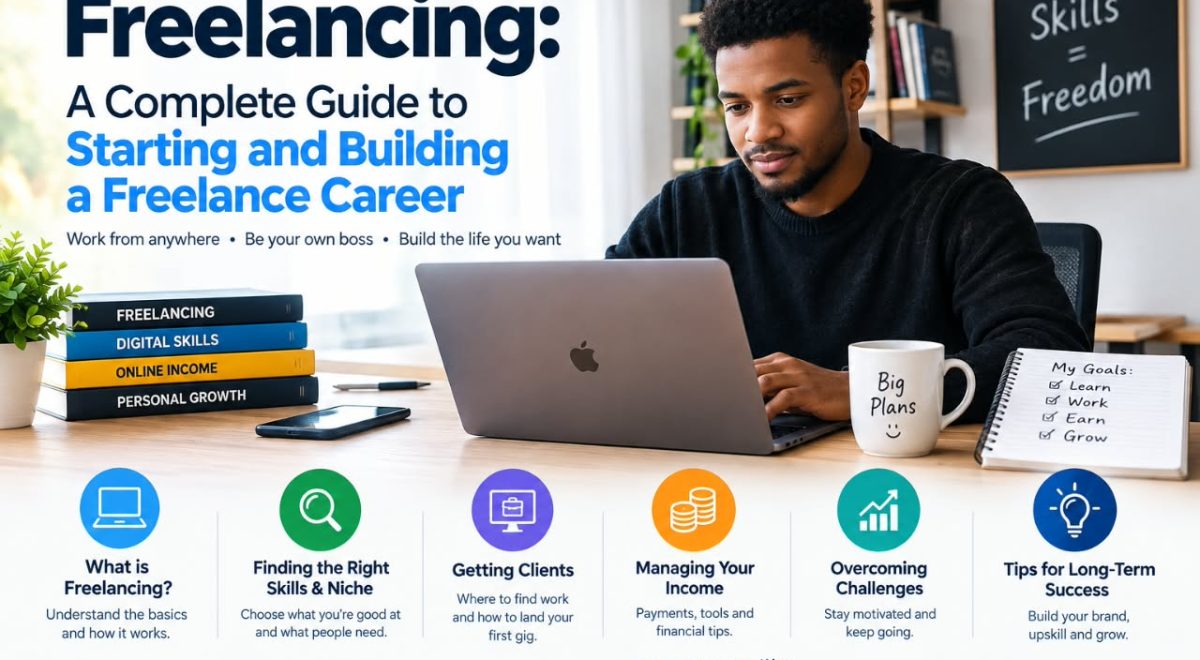
Introduction
Freelancing has become a popular way for people to use their professional skills independently. Instead of working exclusively for one employer, freelancers provide services to different clients or businesses, usually on a project, contract, or hourly basis.
People freelance in many fields, including writing, graphic design, programming, digital marketing, video editing, translation, bookkeeping, consulting, virtual assistance, and web development.
However, freelancing is not simply about creating an account on a freelance platform and waiting for clients. Building a reliable freelance career requires useful skills, a clear service offering, professional communication, good time management, and the ability to manage client relationships.
This guide explains freelancing from the basics to practical steps for getting started, finding clients, setting prices, managing projects, and developing your career.
What Is Freelancing?
Freelancing is a form of independent work in which a person provides services to clients without necessarily becoming a permanent employee of those clients.
A freelancer may work with one client for a short project or maintain relationships with several clients over a longer period.
For example, a freelance graphic designer might create a company’s logo, social media graphics, and marketing materials. A freelance writer might produce blog articles for several websites.
The exact working arrangement depends on the freelancer, client, contract, location, and type of service.
How Does Freelancing Work?
The basic freelance process is relatively straightforward:
- Choose a service you can provide.
- Develop the required skills.
- Create examples of your work.
- Find potential clients.
- Discuss the project requirements.
- Agree on the scope, price, and deadline.
- Complete and deliver the work.
- Receive payment according to the agreed terms.
- Maintain the relationship when appropriate.
Some freelancers find work through dedicated freelance marketplaces, while others use professional networking, referrals, personal websites, social media, or direct outreach.
Common Types of Freelance Work
Freelancing is available across many industries. The best option depends on your existing skills, interests, experience, and the demand for your services.
Freelance Writing
Freelance writers may create:
- Blog posts
- Website content
- Product descriptions
- Newsletters
- Social media content
- Technical documentation
- Editing and proofreading
Strong writing, research, organization, and communication skills are important for this type of work.
Graphic Design
Graphic designers can provide services such as:
- Logo design
- Social media graphics
- Presentation design
- Advertising materials
- Business documents
- Brand assets
Designers typically need both creative ability and familiarity with relevant design software.
Web Development
Freelance developers may build or maintain:
- Business websites
- E-commerce websites
- Web applications
- Landing pages
- Content management systems
- Website integrations
Development projects can range from simple website updates to complex applications.
Digital Marketing
Freelance marketing professionals may specialize in:
- Search engine optimization
- Content marketing
- Social media management
- Email marketing
- Marketing strategy
- Paid advertising
Because marketing services can involve business budgets and performance goals, clear communication and realistic expectations are especially important.
Video Editing
Video editors can work on:
- YouTube videos
- Short-form social content
- Educational videos
- Business presentations
- Promotional videos
- Interviews
The work often requires technical editing skills as well as an understanding of pacing, storytelling, audio, and visual presentation.
Virtual Assistance
Virtual assistants can help businesses with administrative tasks such as:
- Email organization
- Scheduling
- Data entry
- Online research
- Document management
- Customer support
The exact responsibilities depend on the client.
I would recommend that you learn either Graphic Design , Web Development or both so that you can take advantage of the freelance opportunities available today.
Benefits of Freelancing
Freelancing can offer several advantages, although the experience differs from person to person.
Greater Work Flexibility
Many freelancers have more control over when and where they work than traditional employees. This can make it easier to organize work around other responsibilities.
However, flexibility does not mean that freelancers have no schedule. Meeting deadlines and responding to clients still requires discipline.
Opportunity to Choose Projects
Freelancers can often decide which services and projects they want to pursue.
As their experience develops, they may choose to specialize in a particular industry or type of client.
Ability to Develop Multiple Skills
Freelancing can expose people to different businesses, industries, tools, and customer requirements.
A freelancer may improve not only their technical skill but also their communication, sales, project management, negotiation, and organizational abilities.
Potential for Long-Term Client Relationships
A successful project can sometimes lead to additional work. Building professional relationships can therefore be valuable over time.
This does not mean every client will become a long-term customer. Freelancers should continue developing their skills and looking for appropriate opportunities.
Challenges and Disadvantages of Freelancing
Freelancing also comes with responsibilities that are sometimes overlooked.
Income Can Be Inconsistent
Unlike a traditional salaried position, freelance income may vary from month to month.
Some periods may contain many projects, while others may be quieter. Freelancers should plan their finances carefully rather than assuming that work will always be available.
Finding Clients Takes Work
Finding clients is often one of the most difficult parts of starting a freelance career.
A strong skill alone does not guarantee clients. Freelancers also need to present their services clearly, communicate professionally, demonstrate relevant work, and build credibility.
You Manage Your Own Business Tasks
Freelancers may need to handle responsibilities beyond completing projects, including:
- Client communication
- Invoicing
- Scheduling
- Contracts
- Record keeping
- Marketing
- Taxes and local business requirements
The specific legal and tax responsibilities depend on where the freelancer lives and operates.
Work and Personal Time Can Overlap
Working from home or setting your own schedule can make it difficult to separate professional and personal time.
Creating working hours and realistic project deadlines can help prevent this problem.
How to Start Freelancing as a Beginner
You do not need to offer ten different services when starting. A focused approach is usually easier to manage.
Step 1: Choose One Marketable Skill
Start with a skill you already understand or are willing to learn seriously.
For example, you could choose:
- Writing
- Graphic design
- Video editing
- Web development
- Translation
- Virtual assistance
- SEO
- Social media management
Consider your existing abilities and the type of work you genuinely want to perform.
Step 2: Learn the Fundamentals
If your skill is not yet strong enough for professional work, spend time learning and practicing before accepting demanding projects.
Use reliable educational resources, documentation, courses, tutorials, and practical exercises.
The goal is not simply to collect certificates. You should be able to demonstrate that you can solve real client problems.
Step 3: Create a Portfolio
A portfolio gives potential clients evidence of what you can do.
If you do not have previous clients, you can create sample projects that demonstrate your abilities.
For example, an aspiring writer could create several high-quality sample articles. A designer could create sample brand materials. A web developer could build demonstration websites.
Clearly label sample or practice projects so visitors understand what they are viewing.
Step 4: Define Your Service
Avoid describing yourself too broadly.
Instead of saying:
“I do everything related to marketing.”
You could offer a more specific service such as:
“I create SEO-friendly blog content for small businesses.”
A clear service makes it easier for potential clients to understand what you offer.
Broad → Specific Examples
- Graphic Design → Social Media Graphic Design
- Writing → SEO Blog Writing for Small Businesses
- Web Development → WordPress Websites for Small Businesses
- Video Editing → Short-Form Video Editing for Creators
My Practical Recommendation:
Choose a service that is specific enough for potential clients to understand clearly, but broad enough to give you several related project opportunities. As you gain experience, you can refine your service based on the type of work you enjoy, perform well, and want to attract.
Step 5: Create a Professional Profile
If you use a freelance marketplace or professional network, make your profile clear and honest.
Include:
- Your main skill
- Services you provide
- Relevant experience
- Portfolio samples
- Tools you use
- Professional introduction
- Areas you specialize in
Do not claim experience, qualifications, or results that you do not have.
Step 6: Start Looking for Suitable Projects
Search for projects that match your skills and current experience.
When applying, avoid sending the same generic message to every client. Read the project requirements and explain briefly how your skills relate to their needs.
A useful proposal should focus on the client’s project rather than simply describing yourself.
Bad vs. Better Proposal Structure
A weak proposal may be too general and focus mainly on the freelancer rather than the client’s needs.
Weak Example:
“Hello, I am an expert freelancer. I can do your project. Please hire me.”
A better proposal should be more specific and relevant to the project. It can:
- Mention the client’s specific need
- Explain your relevant skill
- Describe your approach
- Add one relevant sample
- Ask one useful question
Proposal Checklist
Before sending a proposal, check that you have:
- Addressed the client’s specific requirement
- Explained why your skill is relevant
- Briefly described how you would approach the project
- Included one relevant sample when appropriate
- Asked a useful question if clarification is needed
- Kept the proposal clear and concise
Step 7: Communicate Clearly
Before accepting a project, make sure both sides understand:
- What needs to be delivered
- The deadline
- Number of revisions
- Price or payment structure
- Required files or materials
- How changes will be handled
Clear expectations can prevent many misunderstandings.
How to Find Freelance Clients
There are several ways to find freelance opportunities.
Freelance Marketplaces
Freelance platforms can connect clients with independent professionals.
These platforms may provide features for profiles, proposals, project management, communication, and payments. However, freelancers should understand each platform’s current rules, fees, eligibility requirements, and payment policies before relying on it.
Professional Networking
Networking can help freelancers discover opportunities through professional relationships.
Participating in relevant communities, maintaining a professional online presence, and connecting with people in your industry can gradually expand your network.
Referrals
Satisfied clients may recommend a freelancer to other businesses or individuals.
Providing dependable work and professional communication can make referrals more likely, although they should never be treated as guaranteed.
Personal Website
A personal website can serve as a central place to display:
- Your services
- Portfolio
- About page
- Contact information
- Testimonials, where genuine and permitted
- Relevant articles or resources
A website can also help establish a professional online presence outside freelance marketplaces.
Client-Finding Comparison
Different client-finding methods have different advantages, limitations, and levels of suitability depending on a freelancer’s experience, service, and target clients.
| Method | Main Advantage | Main Limitation | Suitable For |
|---|---|---|---|
| Freelance marketplaces | Access to existing opportunities | Competition can be high | Beginners |
| Direct outreach | Allows you to target specific clients | Requires research and communication | Freelancers with a clear service |
| Referrals | Builds on existing relationships | Depends on your network | Experienced freelancers |
| Professional networking | Helps develop long-term connections | Results can take time | Professionals |
| Personal website | Creates a professional online presence | Needs a way to attract visitors | Portfolio-focused freelancers |
What This Comparison Shows
There is no single client-finding method that works the same way for every freelancer. The most suitable approach depends on factors such as your experience, service, target clients, and existing network.
A beginner may start by testing one or two methods and tracking which ones generate relevant opportunities and responses. As experience and professional connections grow, other methods can become more useful.
My Practical Recommendation:
Start with the client-finding method that best matches your current situation instead of trying to use every channel at once. Focus on one or two methods consistently, measure the results, and gradually expand your approach as your freelance business develops.
How to Set Freelance Prices
Pricing is one of the areas beginners often find difficult.
There is no single correct freelance rate. Pricing can depend on factors such as:
- Your experience
- Skill level
- Service complexity
- Project scope
- Deadline
- Client requirements
- Local market conditions
- Platform fees
- Business expenses
Hourly Pricing
With hourly pricing, you charge according to the time spent working.
This can be useful when the project scope is uncertain or when clients specifically request hourly work.
Project-Based Pricing
With project-based pricing, you agree on a price for a defined deliverable.
For example, a designer might charge a specific amount for a defined set of graphics.
This approach works best when the project scope is clearly defined.
Retainer Arrangements
Some freelancers work with clients on recurring arrangements where a client pays for an agreed level of ongoing service.
The terms should clearly explain what work is included and what happens when additional work is requested.
A Simple Pricing Checklist
Before setting a freelance price, consider the total work involved in the project, not just the final deliverable.
A useful pricing checklist includes:
- Estimated work time
- Number of revisions
- Client communication
- Research and preparation
- Tools or platform costs
- File preparation and delivery
- Project complexity
For example, a blog writing project may appear to involve only writing the final article. However, the freelancer may also need to research the topic, communicate with the client, review the requirements, make revisions, format the document, and prepare the final files.
This means the price should reflect the overall work required to complete the project, rather than being based only on the final output.
Avoid Competing Only on Price
Being the cheapest freelancer is not necessarily a good long-term strategy.
Instead, focus on providing clear value, reliable communication, quality work, and a professional experience.
Freelancing Platforms vs Finding Clients Directly
Both approaches have advantages and disadvantages.
| Approach | Advantages | Limitations |
|---|---|---|
| Freelance platforms | Easier access to potential clients and structured project systems | Competition, platform rules, and possible fees |
| Direct outreach | More control over relationships and business process | Requires finding prospects and building trust |
| Referrals | Can lead to strong relationships | Depends on your existing network and past work |
| Personal website | Builds an independent professional presence | Requires time and effort to attract visitors |
A freelancer does not necessarily have to choose only one method. Different approaches can complement each other.
How to Avoid Common Freelancing Problems
Do Not Accept Unclear Projects
If you do not understand what a client expects, ask questions before starting.
A vague project can become difficult when the client and freelancer have different interpretations of the deliverables.
Set Realistic Deadlines
Do not promise a deadline simply because you want to win the project.
Consider your existing workload, project complexity, and potential revisions before committing.
Keep Project Details in Writing
Important agreements should be documented. Written communication can help both parties remember the scope, deadlines, price, and deliverables.
For larger projects, an appropriate written contract can provide additional clarity.
Protect Your Time
Freelancers need to manage their available hours carefully.
If several projects have overlapping deadlines, quality and communication can suffer.
Be Careful With Unusual Payment Requests
Freelancers should be cautious when a potential client asks them to perform unusual financial transactions, purchase questionable items, share sensitive account information, or move payments through methods that create unnecessary risk.
Use reputable payment processes and understand the rules of the platform or service you are using.
How to Build a Strong Freelance Portfolio
A good portfolio should demonstrate your ability rather than simply contain a large number of files.
Include your strongest and most relevant examples.
For each project, consider explaining:
- The client’s goal or the purpose of the project
- Your role
- What you created
- Tools or skills used
- The final deliverable
If a project contains confidential information, do not publish private client materials without appropriate permission.
How to Build Long-Term Freelance Success
Getting the first project is only one part of freelancing. A sustainable career requires continuous improvement.
Improve Your Skills
Technology, tools, and client expectations change over time.
Continue learning within your field and keep your skills relevant.
Develop a Specialty
As you gain experience, specialization can make your services easier to understand.
For example, instead of being a general writer, you might specialize in technical content, business content, or educational writing.
A specialty is not mandatory, but it can help differentiate your services.
Track Your Projects
Keep organized records of projects, deadlines, payments, expenses, and client requirements.
A simple spreadsheet or project management system can be enough when starting.
Build Professional Relationships
Treat clients respectfully, communicate clearly, and deliver what you agreed to provide.
Professionalism can be just as important as technical ability.
Freelancing Skills That Matter Beyond Technical Knowledge
A freelancer needs more than a technical skill.
Communication
You need to understand requirements and explain your ideas clearly.
Time Management
Managing multiple deadlines is an important part of independent work.
Problem Solving
Clients usually hire freelancers because they need a problem solved or a task completed.
Organization
Keeping files, messages, deadlines, invoices, and project information organized reduces avoidable mistakes.
Adaptability
Different clients may use different tools and workflows. Being able to adapt can make collaboration easier.
Is Freelancing Right for Everyone?
Freelancing can be a good option for people who value independence and are comfortable managing uncertainty and business responsibilities.
However, it may not suit someone who strongly prefers a predictable work schedule, fixed responsibilities, or the structure of traditional employment.
The right choice depends on your circumstances, skills, financial situation, career goals, and tolerance for uncertainty.
You can also combine freelancing with other forms of employment or education where appropriate, depending on your circumstances and any applicable employment rules.
Common Freelancing Mistakes Beginners Should Avoid
Some mistakes can make freelancing unnecessarily difficult.
Offering Too Many Services
Trying to offer every possible service can make your profile confusing.
Start with a focused service and expand as your skills develop.
Working Without Understanding the Scope
Starting work before confirming the requirements can lead to disagreements later.
Underestimating Project Time
A project that appears simple may involve research, communication, revisions, formatting, and administrative work.
Consider the complete workload when planning your time and price.
Ignoring Client Communication
Even good work can create problems if communication is poor.
Keep clients informed when important issues arise.
Depending on One Source of Work
Building several legitimate ways to find opportunities can reduce dependence on a single platform or client.
Frequently Asked Questions About Freelancing
1. What is freelancing in simple terms?
Freelancing means providing professional services independently to clients rather than working exclusively as a permanent employee for one organization. Freelancers may work on individual projects, hourly assignments, contracts, or recurring arrangements.
2. Can a beginner start freelancing?
Yes. Beginners can start by learning a marketable skill, practicing it, creating a portfolio, defining a clear service, and applying for suitable projects. Building professional experience usually takes time.
3. What skills are good for freelancing?
Many skills can be used for freelancing, including writing, graphic design, programming, web development, video editing, translation, digital marketing, bookkeeping, and virtual assistance. The best choice depends on your abilities and the services clients need.
4. How do freelancers find clients?
Freelancers can find clients through freelance marketplaces, professional networking, referrals, personal websites, social media, and direct business outreach. The best method varies by industry and experience level.
5. Is freelance income guaranteed?
No. Freelance income is generally not guaranteed. Work availability can change, and earnings may vary depending on clients, projects, skills, demand, pricing, and other factors. Freelancers should plan accordingly.
Conclusion
Freelancing can provide a flexible way to turn professional skills into independent work, but it should be approached as a career or business activity rather than a shortcut to easy money.
A strong foundation starts with one useful skill, practical experience, a focused portfolio, clear communication, realistic pricing, and reliable project management.
As you gain experience, you can refine your services, build professional relationships, develop a specialty, and create multiple ways to find appropriate clients.
The most useful approach is to focus on delivering genuine value. Learn continuously, communicate honestly, protect your time, understand your responsibilities, and set realistic expectations. With those fundamentals in place, freelancing can become a practical part of a broader professional career.