


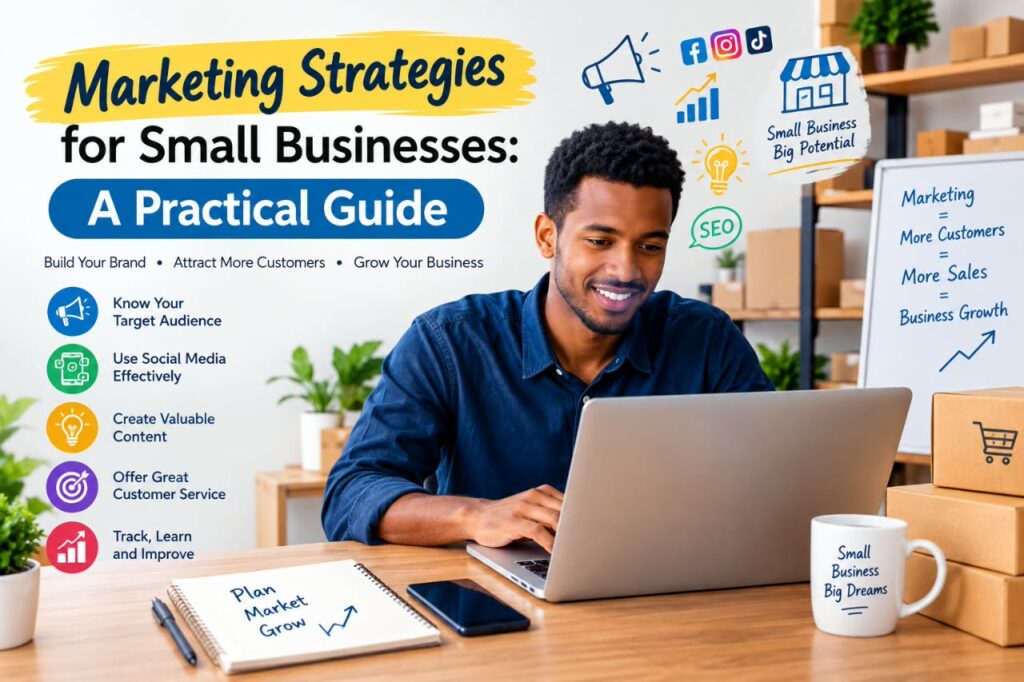
Marketing can be challenging for a small business, especially when you have limited time, staff, and budget. The good news is that effective marketing does not always require a large advertising budget. A clear understanding of your customers, a focused message, and consistent execution can help you make better use of the resources you already have.
The right marketing strategies depend on your business, target audience, location, products or services, and goals. A strategy that works well for an online store may not be suitable for a local service business.
This guide explains practical marketing strategies for small businesses, including content marketing, social media, email marketing, search engine optimization, local marketing, paid advertising, and customer retention. It also explains how to choose the right approaches and measure whether they are actually helping your business.
What Are Marketing Strategies?
Marketing strategies are planned approaches a business uses to attract potential customers, communicate its value, generate sales, and build long-term customer relationships.
A strategy is broader than a single marketing activity. For example, posting a photo on social media is an activity, while using social media to reach a specific customer group, communicate your brand message, and generate website visits can be part of a larger strategy.
A useful marketing strategy should answer several basic questions:
- Who are you trying to reach?
- What problem does your business solve?
- Why should customers consider your product or service?
- Where can you reach your target audience?
- What action do you want customers to take?
- How will you measure the results?
Answering these questions before spending money can help prevent wasted effort.
Why Marketing Strategies Matter for Small Businesses
Small businesses often have fewer resources than larger companies. This makes focus particularly important.
Instead of trying every available marketing channel, a small business can select a few channels that are appropriate for its audience and goals.
Good marketing strategies can help a business:
- Increase awareness of its products or services
- Reach potential customers
- Explain what makes the business different
- Build relationships with existing customers
- Generate website traffic or inquiries
- Encourage repeat purchases
- Understand which marketing activities are producing useful results
Marketing does not guarantee sales. Customer demand, pricing, product quality, competition, service, timing, and many other factors also influence business performance.
1. Define Your Target Audience
One of the first steps in small business marketing is understanding who you want to reach.
Trying to market to everyone can make your message too general. Instead, identify the people who are most likely to benefit from what you offer.
Consider factors such as:
- Age range
- Location
- Occupation or business type
- Interests
- Common problems
- Buying habits
- Budget
- Preferred communication channels
For example, a local graphic design business may focus on small companies that need logos, social media graphics, brochures, or website visuals.
Create a Simple Customer Profile
You do not need complicated research to start. Create a simple description of your ideal customer.
For example:
Customer: Small business owner
Need: Professional social media graphics
Problem: Does not have time or design skills
Goal: Maintain a consistent online appearance
Preferred channel: Search engines, social media, and referrals
This profile can help guide your content and promotional decisions.
2. Build a Clear Marketing Plan
A marketing strategy becomes easier to manage when it is turned into a simple plan.
Start by defining a specific goal.
Instead of saying:
“I want more customers.”
Use a more measurable goal such as:
“I want to increase qualified inquiries from my website over the next three months.”
Then decide:
- What audience you want to reach
- Which marketing channels you will use
- What content or offer you will provide
- How frequently you will publish or promote it
- Which metrics you will monitor
A small business does not need a complicated marketing document. A one-page plan can be enough to establish priorities.
3. Use Search Engine Optimization
Search engine optimization, commonly called SEO, helps make your website easier for search engines and users to understand.
SEO can be particularly useful for businesses that answer questions or provide products and services that people actively search for.
For example, a website selling web design services might create useful content around topics such as:
- How to choose a website designer
- What a small business website should include
- Website design mistakes to avoid
- How to improve a business website
Focus on Search Intent
Do not choose keywords simply because they have high search volume.
Think about what the person searching actually wants.
Someone searching for “what is email marketing” is likely looking for information, while someone searching for “email marketing software for small business” may be comparing solutions.
Your content should match that intent.
Improve Your Website Basics
Useful SEO practices include:
- Creating descriptive page titles
- Writing useful meta descriptions
- Using clear headings
- Making pages easy to navigate
- Adding relevant internal links
- Optimizing images appropriately
- Improving mobile usability
- Creating original, useful content
- Keeping important business information easy to find
SEO generally requires patience. Rankings and organic traffic can change over time, and no legitimate strategy can guarantee a particular position in search results.
4. Create Helpful Content
Content marketing involves creating useful information that helps your target audience.
For a small business, content could include:
- Blog articles
- Tutorials
- Guides
- Videos
- Case examples
- Checklists
- Frequently asked questions
- Product demonstrations
- Educational social media posts
The goal should not be to publish content simply to increase the number of pages on your website.
Instead, ask:
“What useful question can I answer for my potential customer?”
For example, a small hosting company could publish an article explaining how to choose hosting for a new business website.
Helpful content can demonstrate knowledge while giving potential customers a reason to visit your website.
5. Use Social Media Strategically
Social media can help small businesses communicate with potential and existing customers.
However, being active on every platform is not necessary.
Choose platforms based on where your target customers are most likely to spend time and where your business can consistently create useful content.
Possible social media activities include:
- Educational posts
- Product demonstrations
- Short tutorials
- Behind-the-scenes content
- Customer questions and answers
- New product announcements
- Business updates
- Links to useful website content
Avoid Posting Without a Purpose
Before publishing a post, consider what you want it to accomplish.
It might be intended to:
- Educate
- Build awareness
- Start a conversation
- Introduce a product
- Drive website visits
- Encourage an inquiry
A simple content calendar can help maintain consistency without requiring daily posting.
6. Try Email Marketing
Email marketing allows businesses to communicate directly with people who have voluntarily subscribed to receive messages.
A small business might use email to send:
- Helpful tips
- New content
- Product updates
- Special offers
- Company news
- Educational resources
The quality of the audience matters more than simply collecting a large number of email addresses.
Use clear signup processes and communicate what subscribers can expect. Avoid sending excessive or irrelevant messages.
7. Use Local Marketing
Local businesses can benefit from strategies designed specifically for people in their service area.
Examples include:
- Maintaining accurate business information online
- Creating location-specific website content
- Encouraging genuine customer reviews
- Participating in local events
- Building relationships with complementary businesses
- Using local search optimization
- Supporting relevant community activities
For example, a local photography business could create pages describing its services for weddings, businesses, or events in the areas it actually serves.
The information should be accurate rather than creating unnecessary location pages simply to attract search traffic.
8. Encourage Referrals and Word-of-Mouth Marketing
Satisfied customers can become an important source of new business.
A referral strategy can be simple. After providing a good experience, you can make customers aware that referrals are welcome.
Depending on the business, you might also create a legitimate referral program with clearly explained terms.
However, referrals should be based on genuine customer relationships rather than misleading incentives or fabricated reviews.
Make Customer Experience Part of Marketing
Marketing may attract someone to your business, but the customer experience can influence whether they return or recommend you.
Pay attention to:
- Communication
- Reliability
- Product quality
- Delivery or completion times
- Customer support
- Clear pricing
- Handling of complaints
Good marketing cannot permanently compensate for a poor customer experience.
9. Consider Paid Advertising Carefully
Paid advertising can help businesses reach specific audiences, but it should be approached carefully.
Common options include:
- Search advertising
- Social media advertising
- Display advertising
- Sponsored content
- Local advertising
Before spending money, establish a clear objective.
For example, you may want to generate:
- Website visits
- Phone calls
- Form submissions
- Store visits
- Product purchases
Start With a Controlled Budget
A small business can test an advertising campaign with a budget it can afford to lose while learning.
Track the relationship between advertising spending and meaningful business outcomes.
Do not judge an advertising campaign only by clicks. A large number of clicks may have little value if they do not come from relevant potential customers.
10. Build a Strong Business Website
Your website is often an important part of a digital marketing strategy.
A useful small business website should make it easy for visitors to understand:
- What the business does
- Who it serves
- What products or services are available
- How to contact the business
- Where the business operates, when relevant
- What action visitors can take next
Keep navigation simple and make important information easy to find.
Your website should also work well on mobile devices and provide a reasonable user experience.
11. Use Marketing Analytics
Marketing decisions become easier when you measure the right information.
Depending on your business, useful metrics may include:
- Website traffic
- Search impressions
- Search clicks
- Leads
- Conversion rate
- Email engagement
- Social media engagement
- Advertising costs
- Customer acquisition cost
- Repeat purchases
Not every metric is equally important.
For example, a local service business may care more about qualified inquiries than total website visitors.
Review Results Regularly
Set aside time to review your marketing performance.
Ask:
- Which channels are attracting relevant visitors?
- Which content receives useful engagement?
- Which campaigns generate inquiries?
- Which activities consume time without producing meaningful results?
- What should be improved or stopped?
Use the answers to adjust your strategy rather than continuing with an activity simply because you have always done it.
12. Choose Marketing Strategies Based on Your Business
There is no universal marketing strategy that works for every small business.
Consider this simple comparison:
| Strategy | Useful For | Main Advantage | Limitation |
|---|---|---|---|
| SEO | Businesses with searchable topics | Can attract organic visitors | Usually takes time |
| Content marketing | Educational or information-rich businesses | Builds useful resources | Requires consistent effort |
| Social media | Brands with active audiences | Direct communication | Requires ongoing content |
| Email marketing | Businesses with subscribers | Direct communication | Requires permission and good content |
| Local marketing | Location-based businesses | Reaches nearby customers | Limited by service area |
| Paid advertising | Businesses seeking targeted reach | Can provide faster exposure | Requires a budget |
| Referrals | Service and relationship-based businesses | Can build trust | Depends on customer experience |
The best approach may combine several methods rather than relying on one channel.
A Simple Marketing Strategy for a Small Business
If you are starting from scratch, you do not need to implement everything at once.
Try this basic framework:
Step 1: Identify Your Audience
Write down who your most relevant customers are and what problems they need to solve.
Step 2: Define Your Value
Explain clearly what you offer and how it helps your target customer.
Step 3: Build Your Website
Create a professional website with clear information about your products or services and an easy way to contact you.
Step 4: Choose Two or Three Channels
For example, you might combine SEO with social media and email marketing.
Step 5: Create Useful Content
Answer questions your target customers are already asking.
Step 6: Test Your Approach
Monitor traffic, inquiries, conversions, and other relevant metrics.
Step 7: Improve Over Time
Keep the strategies that produce useful results and adjust or discontinue activities that are not working.
Common Small Business Marketing Mistakes
Understanding what to avoid can be just as useful as knowing what to do.
Trying Every Marketing Channel
Managing too many platforms can spread your resources too thin.
Start with the channels most relevant to your audience.
Focusing Only on Promotion
Constantly asking people to buy can make your content less useful.
Balance promotional messages with education, information, and helpful resources.
Ignoring Existing Customers
Businesses sometimes focus entirely on acquiring new customers.
Existing customers can also be valuable, particularly when they return, purchase additional products or services, or recommend the business.
Chasing Vanity Metrics
Likes and followers can be useful indicators of engagement, but they do not automatically represent business growth.
Look at metrics connected to your actual goals.
Expecting Immediate Results
Some strategies, especially SEO and content marketing, can take time to produce meaningful results.
A realistic strategy involves testing, learning, and improving rather than expecting instant success.
How Much Should a Small Business Spend on Marketing?
There is no single marketing budget that is appropriate for every business.
The right amount depends on factors such as:
- Business size
- Revenue
- Industry
- Customer acquisition costs
- Growth objectives
- Available cash flow
- Marketing channels
- Competition
If your budget is limited, prioritize activities that you can execute consistently.
For example, improving your website, creating useful content, building relationships, and maintaining a professional social presence may be more practical initially than running several expensive advertising campaigns.
When spending money on advertising or marketing software, track the costs and evaluate whether the activity is producing worthwhile business outcomes.
How to Improve Your Marketing Strategy Over Time
Marketing should not be treated as a one-time project.
Customer preferences, competition, technology, and platforms can change.
A useful improvement cycle is:
Plan → Test → Measure → Learn → Improve
For example, if a blog article receives search traffic but very few visitors contact the business, you might improve the page’s calls to action, service information, or user experience.
If a social media post generates useful engagement, you can study what made it valuable and create related content.
The goal is continuous improvement rather than simply producing more marketing material.
Frequently Asked Questions
What are the best marketing strategies for small businesses?
There is no single best strategy for every business. SEO, content marketing, social media, email marketing, referrals, local marketing, and paid advertising can all be useful depending on the audience and business model. Start with the channels most closely connected to your customers and goals.
What is the most affordable marketing strategy for a small business?
The cost varies by strategy and business. Creating useful content, improving an existing website, networking, referrals, and organic social media can often be started with relatively limited financial investment, although they still require time and effort.
How long does it take for marketing strategies to work?
The timeframe varies significantly. Paid campaigns can generate exposure quickly, while SEO, content marketing, and relationship-based strategies may take longer. Results also depend on competition, audience demand, execution, and the quality of the offer.
Should a small business use social media and SEO?
They can complement each other, but neither is automatically necessary for every business. SEO can help people discover useful website content through search, while social media can help a business communicate with an audience and distribute content. Choose based on where your customers are and what you can manage consistently.
How can I know whether my marketing strategy is working?
Start by defining measurable goals and tracking relevant metrics. Depending on the business, these might include qualified leads, sales, website inquiries, conversions, search traffic, email engagement, or customer retention. Review the data regularly and make changes based on what you learn.
Conclusion
Effective marketing for a small business is less about doing everything and more about doing the right things consistently.
Start by understanding your target audience and defining a clear value proposition. Then choose a manageable combination of marketing strategies, such as SEO, content marketing, social media, email, local marketing, referrals, or paid advertising.
Measure meaningful results instead of focusing only on surface-level metrics. Give strategies enough time to learn from them, but do not be afraid to adjust approaches that are not producing useful outcomes.
Most importantly, keep the customer at the center of your marketing. Useful information, clear communication, a good customer experience, and honest promotion provide a stronger foundation for sustainable business growth than shortcuts or exaggerated promises.