


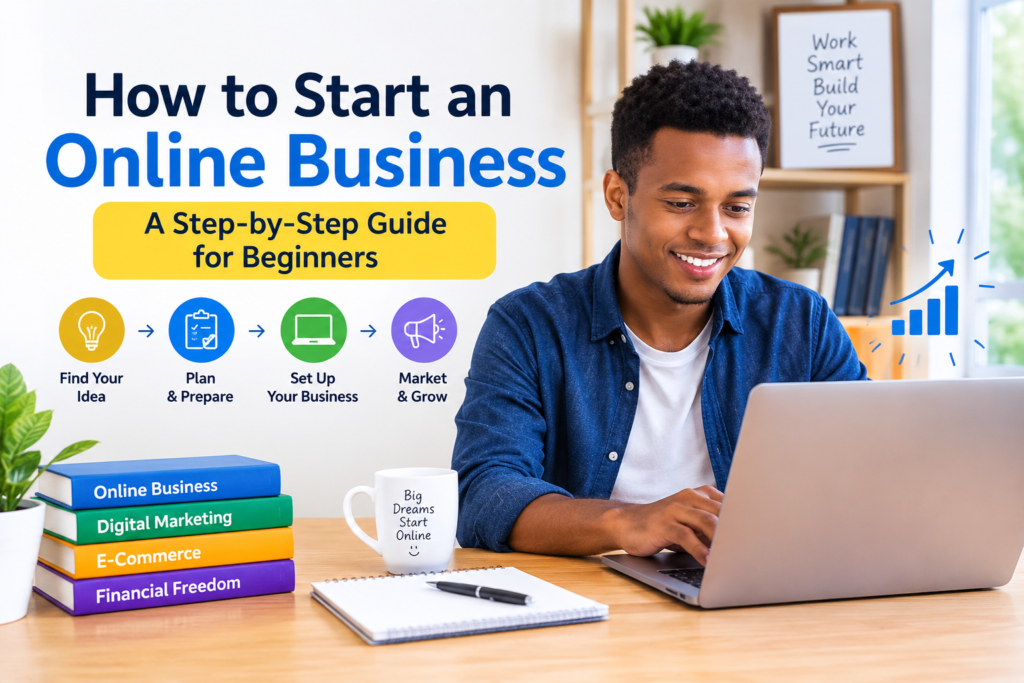
Introduction
Starting an online business can be an accessible way to turn a skill, product, service, or business idea into a real source of income. However, having a website or social media account alone does not make a business successful. You need a clear offer, a specific audience, a practical business model, and a plan for attracting and serving customers.
If you are wondering how to start an online business, the good news is that you do not need to build everything at once. Beginners can start with a simple idea, test whether people are interested, and gradually improve the business as they learn.
This guide explains the major steps involved, from choosing an idea and researching customers to creating an online presence, accepting payments, marketing your business, and measuring progress.
What Is an Online Business?
An online business is a business that uses the internet as an important part of how it operates, markets products or services, communicates with customers, or processes sales.
Examples include:
- Online stores
- Freelance services
- Consulting businesses
- Online education and courses
- Digital products
- Subscription-based services
- Content websites
- Software and web-based services
- Affiliate marketing websites
- Online marketplaces
The right model depends on your skills, resources, target customers, and business goals.
Why Start an Online Business?
Online businesses can offer several practical advantages, although they also come with challenges.
Flexible Business Operations
Depending on the business model, some online businesses can be operated remotely. This can make it easier to organize work around other responsibilities.
Access to a Wider Market
The internet allows a business to reach customers beyond its immediate local area. However, reaching a wider audience does not automatically mean generating sales. The business still needs a useful product or service and an effective marketing strategy.
Different Startup Requirements
Some online businesses require relatively little equipment to begin. For example, a freelancer may primarily need a computer, internet connection, relevant skills, and a way to communicate with clients.
Other businesses, such as ecommerce stores, may require inventory, packaging, shipping arrangements, payment processing, and customer support.
Opportunity to Start Small
One advantage of an online model is that you can often begin with a limited version of your idea, learn from customers, and expand gradually instead of building a large operation immediately.
How to Start an Online Business Step by Step
There is no single formula that works for every business, but the following process provides a useful starting point.
Step 1: Choose a Business Idea
The first step is deciding what you will offer.
A strong business idea generally connects three things:
- A specific customer need
- Something you can provide effectively
- A realistic way to earn revenue
You might start with a skill you already have, a problem you understand, or a product that solves a particular customer need.
For example, someone with graphic design skills could offer logo and social media design services. Someone knowledgeable about a particular subject could create educational resources. Someone interested in physical products could explore an ecommerce business.
Avoid choosing an idea simply because it appears popular online. A business model that works for one person may not be suitable for another.
Questions to Ask About Your Idea
Before committing significant money or time, ask:
- What problem does this business solve?
- Who specifically needs the solution?
- What will customers actually pay for?
- Who are the competitors?
- What makes my offer useful or different?
- Can I realistically deliver the product or service?
- What costs will I have?
These questions can expose weaknesses before they become expensive problems.
Step 2: Define Your Target Audience
Trying to sell to everyone can make marketing unnecessarily difficult.
Instead, describe the type of customer you want to serve.
For example, instead of saying:
“My business helps everyone who wants to learn marketing.”
You could define a narrower audience such as:
“My business provides beginner-friendly marketing resources for small businesses and new entrepreneurs.”
A specific audience makes it easier to develop products, write website content, create advertisements, and communicate your value.
Create a Simple Customer Profile
Consider:
- Age range when relevant
- Location
- Profession or business type
- Main problem
- Goals
- Budget
- Where they search for information
- What influences their purchasing decisions
You do not need to know every personal detail about potential customers. Focus on information that genuinely affects your product and marketing decisions.
Step 3: Research the Market and Competition
Market research helps you understand whether there is a realistic audience for your idea.
Start by examining businesses that already serve similar customers.
Look at:
- Their products or services
- Pricing
- Website structure
- Customer reviews
- Marketing channels
- Frequently asked questions
- Common complaints
- Areas where their offering could be improved
Competition is not necessarily a reason to abandon an idea. In many markets, competition can indicate that customers already spend money on similar solutions.
Your goal is to understand the market and identify how you can provide genuine value.
Step 4: Choose Your Online Business Model
Once you understand your audience and idea, decide how the business will make money.
Service-Based Business
You sell your time, knowledge, or skills.
Examples include:
- Writing
- Graphic design
- Web development
- Consulting
- Virtual assistance
- Video editing
- Digital marketing
This model can be relatively straightforward to test because you may not need physical inventory.
Ecommerce Business
You sell physical products through an online store or marketplace.
You need to consider:
- Product sourcing
- Inventory
- Storage
- Shipping
- Returns
- Customer support
- Payment processing
Digital Products
You can sell downloadable or digitally delivered products such as:
- Templates
- Ebooks
- Educational resources
- Design assets
- Software
- Online courses
Digital products can be delivered online, but they still require useful content, customer support, marketing, and ongoing improvements.
Affiliate Marketing
Affiliate marketing involves promoting products or services offered by other businesses and potentially receiving a commission when qualifying actions occur under the relevant affiliate program’s terms.
Success depends on producing useful content and attracting an audience that is genuinely interested in the products being discussed.
Affiliate programs also have their own eligibility requirements, commission structures, policies, and payment conditions, so review the official terms before relying on one as a business model.
Step 5: Validate Your Business Idea
One of the most important steps is testing your idea before making a large investment.
Validation means finding evidence that potential customers are interested in what you plan to offer.
You could:
- Talk with potential customers
- Publish educational content around the problem
- Offer a small version of the service
- Create a simple landing page
- Ask potential customers for feedback
- Test different offers
- Accept a limited number of early customers
The objective is not to prove that your idea will definitely succeed. No test can guarantee that.
Instead, validation helps you reduce uncertainty and discover what needs to change.
Step 6: Create a Simple Business Plan
You do not necessarily need a complicated document when starting.
A simple plan can include:
Business Idea
What are you selling?
Target Customer
Who is most likely to buy it?
Customer Problem
What problem or need are you addressing?
Value Proposition
Why should customers consider your offer?
Revenue Model
How will the business generate revenue?
Main Costs
What will you need to spend money on?
Marketing Strategy
How will potential customers discover the business?
Short-Term Goals
What do you want to accomplish during the first few months?
Keeping this plan simple makes it easier to update as you learn.
Step 7: Choose a Business Name and Domain
Your business name should be easy to understand, remember, and use consistently.
Before choosing a name, check:
- Domain availability
- Social media username availability
- Existing businesses with similar names
- Relevant trademark considerations
- Local business-registration requirements
Do not assume that a domain being available means the name is legally available for commercial use. Business-name and trademark rules vary by jurisdiction, so check the relevant official sources before making a final decision.
Step 8: Build Your Website
A website can serve as the central location for your online business.
Depending on the business, it may include:
- Homepage
- About page
- Products or services
- Pricing
- Contact page
- Frequently asked questions
- Blog or resources
- Privacy policy
- Terms and conditions
- Refund or return information where applicable
Your website should make it easy for visitors to understand:
What do you offer? Who is it for? Why is it useful? What should they do next?
Keep the Design Simple
A professional website does not need complicated visual effects.
Prioritize:
- Easy navigation
- Readable text
- Clear headings
- Mobile-friendly design
- Fast-loading pages
- Descriptive buttons
- Accurate information
- Accessible contact information
Avoid filling every page with advertisements, pop-ups, or unnecessary elements that make the main content difficult to use.
Step 9: Set Up Payments and Business Operations
Customers need a convenient way to pay if your business sells products or services online.
Depending on your location and business model, options may include:
- Bank payments
- Payment processors
- Mobile payments
- Ecommerce payment systems
- Marketplace payment systems
Availability varies by country, so check the official requirements of the payment provider you plan to use.
You should also establish basic operational processes for:
- Orders
- Invoices
- Customer support
- Refunds
- Returns
- Delivery
- Record keeping
- Data protection
Step 10: Understand Legal and Tax Requirements
Online businesses are still businesses, and legal requirements can apply even when operations happen primarily through the internet.
Depending on your location and business structure, you may need to consider:
- Business registration
- Licenses or permits
- Tax obligations
- Consumer protection rules
- Privacy requirements
- Terms and conditions
- Intellectual property
- Online advertising rules
Requirements differ significantly between countries and business types.
Before launching, consult the appropriate government or regulatory authority in your jurisdiction for current requirements. If the business becomes financially or legally complex, professional legal or accounting advice may also be appropriate.
Step 11: Create Useful Content
Content can help potential customers discover your business and understand your expertise.
Useful content might include:
- Blog articles
- Tutorials
- Guides
- Videos
- Case examples
- Product demonstrations
- Frequently asked questions
- Educational social media posts
For example, a business selling website services could publish articles about website maintenance, domain names, hosting, and common website mistakes.
The purpose should be to genuinely help the audience rather than produce large quantities of repetitive content.
Step 12: Choose the Right Marketing Channels
You do not need to use every marketing platform.
Choose channels that match your audience and resources.
Search Engines
SEO can help useful pages appear in search results for relevant queries.
Good SEO starts with helpful content, clear site structure, descriptive titles, and a positive user experience.
Social Media
Social platforms can help businesses build awareness and communicate directly with potential customers.
Choose platforms where your target audience actually spends time rather than trying to maintain every account.
Email Marketing
Email can help businesses communicate with people who have voluntarily subscribed to receive messages.
Useful emails might include:
- Educational content
- Product updates
- Helpful resources
- Important announcements
- Relevant offers
Respect applicable privacy and marketing laws and give subscribers appropriate control over their communications.
Paid Advertising
Paid advertising can provide another way to reach potential customers, but it involves financial risk.
Start with a clearly defined objective and a controlled budget. Measure the results before increasing spending.
Step 13: Set Realistic Pricing
Pricing is one of the most difficult decisions for new business owners.
Consider:
- Your costs
- Time required to deliver the product or service
- Competitor pricing
- Customer expectations
- Product quality
- Your desired profit margin
- Taxes and transaction fees where applicable
Avoid automatically choosing the cheapest price.
A very low price can make it difficult to cover expenses and may not communicate the value of your offer.
At the same time, charging a high price does not automatically make a product valuable. Your pricing should be supported by the value and quality you actually provide.
Step 14: Launch a Simple Version First
You do not have to wait until everything is perfect.
A small initial launch can help you discover:
- What customers like
- Where they experience difficulties
- Which products receive attention
- Which marketing channels perform better
- What questions customers repeatedly ask
Use this information to improve the business.
A simple launch is often more useful than spending months building features or products that customers may not need.
Step 15: Track Your Business Performance
Once your business is operating, measure what is happening.
Useful metrics may include:
- Website visitors
- Leads
- Conversion rate
- Sales
- Average order value
- Customer acquisition cost
- Repeat purchases
- Refunds
- Revenue
- Business expenses
Do not focus only on website traffic.
A website can receive many visitors without generating meaningful business results. The important measurements depend on your business model and goals.
Common Online Business Mistakes to Avoid
Starting Without Understanding the Customer
A business should solve a real problem or satisfy a real need.
Spending Too Much Before Testing
Buying expensive tools, inventory, or services before validating demand can increase unnecessary risk.
Trying to Serve Everyone
A clearly defined audience usually makes communication and marketing easier.
Copying Competitors
Research competitors for understanding, but develop your own useful products, branding, explanations, and content.
Ignoring Customer Service
Customers remember how a business handles questions, problems, refunds, and complaints.
Expecting Immediate Results
Building an online business generally requires learning, testing, marketing, and improving over time.
Using Too Many Marketing Channels
Managing many platforms can spread your time and attention too thin. Start with channels that are relevant to your audience.
How Much Money Do You Need to Start an Online Business?
There is no universal startup cost.
A service-based business may require fewer upfront expenses than an ecommerce company that needs inventory and shipping infrastructure.
Potential costs can include:
- Domain registration
- Web hosting
- Website software
- Business registration
- Professional services
- Product inventory
- Packaging
- Payment-processing fees
- Advertising
- Software subscriptions
- Internet and equipment
The best approach is to separate essential startup expenses from optional expenses.
For example, if you are starting a freelance writing service, you may need a professional portfolio and reliable communication tools. You may not need an expensive office, advanced software suite, or large advertising budget on day one.
Free vs. Paid Tools for an Online Business
Beginners often wonder whether they should use free or paid tools.
Free Tools
Advantages:
- Lower initial cost
- Useful for experimentation
- Suitable for basic tasks
Limitations:
- Fewer features
- Usage restrictions
- Possible branding limitations
- Less control in some cases
Paid Tools
Advantages:
- More features
- Greater control
- Professional capabilities
- Better scalability in some situations
Limitations:
- Recurring costs
- Learning requirements
- Some tools may provide features you do not actually need
Start with the tools that solve your current problems rather than paying for every available feature.
How to Grow an Online Business
Once you have customers and a functioning process, growth becomes the next challenge.
Improve Your Existing Offer
Customer feedback can reveal opportunities to improve your product, service, pricing, or support.
Develop Related Products
If customers have additional needs that are closely connected to your existing offer, you may be able to create complementary products or services.
Improve Your Marketing
Identify which channels are producing useful results and concentrate your efforts there.
Automate Repetitive Tasks
As the business grows, appropriate software can help automate tasks such as scheduling, email delivery, invoicing, or order processing.
Automation should improve efficiency without making customer interactions unnecessarily difficult.
Protect Quality as You Grow
Growth is not useful if customer service and product quality decline.
Build processes that allow you to handle additional customers while maintaining a consistent experience.
Online Business Ideas for Beginners
If you are still choosing an idea, consider models based on your existing skills and resources.
Possible options include:
- Freelance writing
- Graphic design
- Web development
- Video editing
- Virtual assistance
- Online tutoring
- Consulting
- Digital products
- Niche ecommerce
- Affiliate content websites
- Photography services
- Social media management
- Online courses
- Software services
These are business models, not guaranteed income opportunities. Each has different competition, costs, customer expectations, and skill requirements.
Frequently Asked Questions
Can I start an online business with no experience?
Yes, beginners can start learning and building an online business without previous business ownership experience. However, you will still need to develop relevant skills, understand your customers, and learn basic business operations.
Starting small can make the learning process more manageable.
What is the easiest online business to start?
There is no single easiest option for everyone. A service business can be relatively simple to test when you already have a marketable skill because it may not require physical inventory.
The best option depends on your skills, resources, market, and goals.
How much does it cost to start an online business?
The cost varies considerably. A service-based business may have relatively low initial expenses, while ecommerce, software, or inventory-based businesses can require substantially more investment.
Create a basic budget that includes essential setup, operating, marketing, and transaction costs.
How long does it take to make money from an online business?
There is no reliable universal timeline. Some businesses may obtain customers relatively quickly, while others take considerable time to build an audience and establish demand.
Avoid anyone promising guaranteed income or instant results.
Do I need a website to start an online business?
Not necessarily. Some businesses can begin through marketplaces, social platforms, or other online services.
However, having your own website can provide a central place to explain your business, publish useful information, communicate with customers, and establish your online presence.
Conclusion
Learning how to start an online business is less about finding a secret formula and more about building a useful business step by step.
Start by choosing a realistic idea, identifying a specific audience, researching the market, and selecting a business model that fits your resources. Then create a simple online presence, establish your basic operations, understand applicable legal requirements, and begin marketing through channels that make sense for your customers.
Most importantly, do not confuse launching with finishing. An online business should evolve as you learn from customers, competitors, analytics, and real-world experience.
Start with a manageable version of your idea, keep your costs under control, provide genuine value, and improve the business based on evidence rather than unrealistic promises.