


Introduction
Digital marketing has become an important part of how businesses communicate with potential customers. Whether you run a small local business, an online store, a professional service, or a growing website, digital channels can help you reach people, build relationships, and generate interest in what you offer.
However, having a website or posting occasionally on social media is not the same as having an effective digital marketing strategy.
Successful marketing starts with understanding your audience, creating useful content, choosing the right channels, and measuring what happens after you publish or promote something. The goal is not to be everywhere. It is to use the channels that make sense for your business and audience.
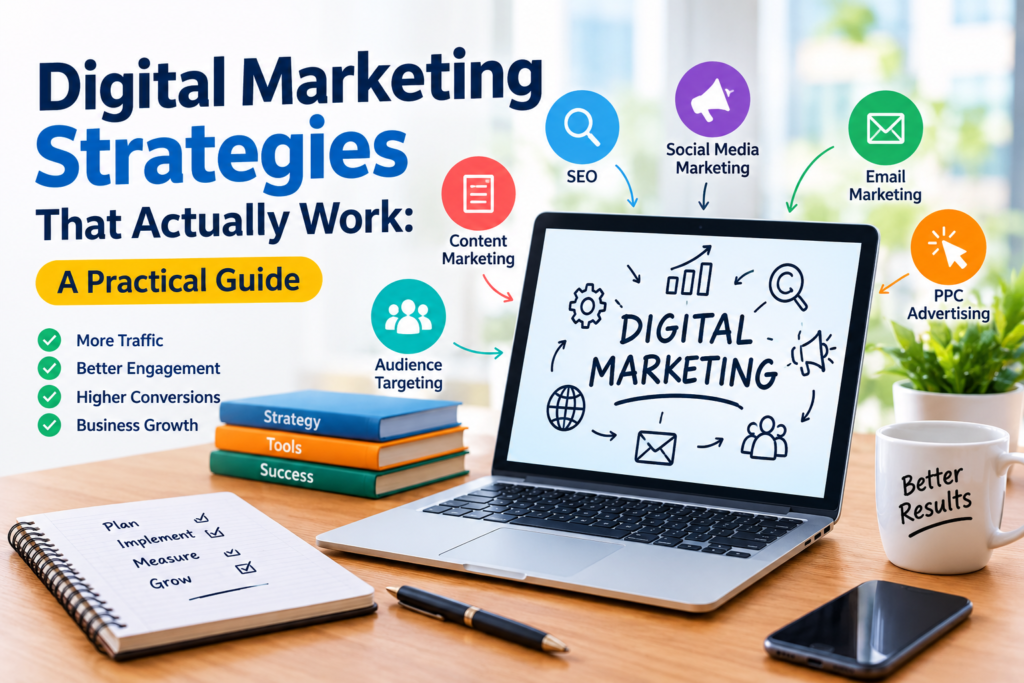
This guide explains practical Digital Marketing strategies, how they work, their advantages and limitations, and how to build a sustainable approach.
What Is Digital Marketing?
Digital marketing is the use of online channels and digital technologies to promote products, services, brands, or ideas.
Common digital marketing channels include:
- Search engines
- Websites and blogs
- Social media
- Online advertising
- Video platforms
- Content marketing
- Mobile applications
- Online communities
These channels can serve different purposes.
For example, search engine optimization can help people discover useful content when they search for information. Email marketing can help a business communicate with people who have chosen to receive messages. Social media can help businesses build awareness and interact with their audience.
A good strategy connects these activities instead of treating them as completely separate tasks.
Why Digital Marketing Matters for Modern Businesses
Traditional marketing methods can still be useful, but digital channels offer businesses additional ways to reach and communicate with audiences.
One important advantage is the ability to create different types of experiences for different stages of the customer journey.
Someone may first discover a company through a search result. Later, they might read a blog article, watch a video, subscribe to an email list, and eventually decide to purchase a product.
Digital marketing can support each stage.
It Can Increase Online Visibility
A well-structured website and useful content can make it easier for people to discover a business online.
It Can Support Customer Relationships
Social media, email newsletters, and helpful content provide opportunities to communicate with existing and potential customers.
It Can Provide Measurable Information
Digital platforms often provide data about activities such as website visits, engagement, conversions, and advertising performance.
That information can help marketers make better decisions.
It Can Work With Different Budgets
Some digital marketing activities require little direct spending, while others require advertising budgets or specialist services.
This makes it possible to build a strategy around available resources rather than assuming every business needs the same marketing budget.
1. Start With a Clear Target Audience
One of the most important digital marketing strategies is understanding who you are trying to reach.
A business that attempts to market to everyone may struggle to create relevant messaging.
Start by identifying:
- Who your ideal customers are
- What problems they are trying to solve
- What information they need
- What motivates them to take action
- Where they spend time online
- What questions they commonly ask
You do not need to create an extremely complicated customer profile.
A simple description can be enough to guide your content and campaigns.
For example, instead of targeting “everyone interested in fitness,” a website might focus on beginners looking for practical home exercise information.
That narrower audience makes it easier to create relevant content.
2. Build a Useful, Search-Friendly Website
Your website is often the foundation of your digital presence.
A good website should make it easy for visitors to understand:
- What the business offers
- Who it serves
- How to contact the business
- Where to find important information
- What action visitors can take next
Your website should also work well on mobile devices and load efficiently.
Create Clear Navigation
Visitors should not have to search through multiple pages to find important information.
Use a logical menu structure and organize related content into useful categories.
For example, a marketing website might have sections such as:
- Digital Marketing
- SEO
- Content Marketing
- Social Media
- Email Marketing
- Business Guides
Clear organization improves the experience for both new and returning visitors.
3. Use SEO to Earn Relevant Search Traffic
Search engine optimization, commonly called SEO, involves improving your website and content so that search engines can understand and potentially surface your pages for relevant searches.
SEO should begin with the reader’s needs.
Instead of repeatedly inserting a keyword into an article, identify the question behind the search and provide a genuinely useful answer.
Practical SEO Steps
Start with:
- Research relevant topics and search queries.
- Create original and useful content.
- Use descriptive page titles.
- Organize articles with clear headings.
- Write useful meta descriptions.
- Link related pages naturally.
- Make pages mobile-friendly.
- Improve page performance where possible.
- Keep important information accurate and up to date.
- Review search performance and improve weak pages.
SEO generally requires patience. Publishing an article does not guarantee that it will rank highly or generate traffic.
4. Create a Strong Content Marketing Strategy
Content marketing focuses on creating and distributing useful information for a specific audience.
Content can include:
- Blog posts
- Tutorials
- Guides
- Videos
- Infographics
- Case studies
- Checklists
- Newsletters
- Educational social media posts
The best content usually solves a specific problem or answers a meaningful question.
For example, a website that sells website design services could publish an article explaining how to prepare content for a new business website.
The article helps readers while naturally demonstrating the type of knowledge the business provides.
Follow a Content Strategy Instead of Posting Randomly
Before publishing, ask:
Who is this content for?
What problem does it solve?
What makes it useful?
What should the reader do after reading it?
These questions can prevent your website from becoming a collection of unrelated articles.
5. Use Social Media Strategically
Social media can help businesses distribute content, communicate with customers, and increase brand awareness.
But businesses do not necessarily need to use every social network.
Choose platforms based on where your target audience is active and what type of content you can consistently produce.
For example:
- Visual businesses may benefit from image and video-focused platforms.
- Professional companies may prefer professional networking platforms.
- Businesses with strong educational content may use video or long-form platforms.
Focus on Value
A social media strategy can include:
- Educational posts
- Short tutorials
- Product explanations
- Behind-the-scenes content
- Frequently asked questions
- Customer service responses
- Links to useful resources
Constantly promoting products can make an account less useful to followers.
A balanced approach is generally more sustainable.
6. Use Email Marketing to Stay Connected
Email marketing allows businesses to communicate directly with people who have voluntarily subscribed to receive messages.
A useful email strategy might include:
- Welcome emails
- Educational newsletters
- Product updates
- Helpful resources
- Special offers
- New content notifications
The key is relevance.
Do not send messages simply because you have an email list. Each message should have a clear reason for being sent and should respect applicable privacy and marketing requirements.
Provide a Clear Reason to Subscribe
People are more likely to subscribe when they understand what they will receive.
For example:
“Receive one practical marketing guide every week.”
A clear expectation is better than a vague promise.
7. Consider Paid Digital Advertising
Paid advertising can help businesses place their offers in front of specific audiences through search engines, social networks, websites, and other platforms.
Common advertising approaches include:
- Search advertising
- Social media advertising
- Display advertising
- Video advertising
- Remarketing
Paid advertising can provide faster exposure than waiting for organic traffic, but it costs money and requires careful management.
Start With a Controlled Budget
Before spending heavily, determine:
- Your campaign objective
- Your target audience
- Your advertising budget
- Your landing page
- Your conversion goal
- How performance will be measured
Do not assume that increasing the advertising budget automatically improves results.
A poorly designed campaign can simply spend more money without solving the underlying problem.
8. Create Landing Pages That Match User Intent
A landing page is a page designed around a particular marketing objective.
For example, an advertisement for a specific online course should ideally lead to a page that explains that course rather than sending visitors to a generic homepage.
A useful landing page should clearly communicate:
- The offer
- Who it is for
- The main benefits
- Important details
- Pricing when relevant
- Frequently asked questions
- A clear next step
Avoid making exaggerated claims just to increase conversions.
Clear and honest information builds stronger long-term trust.
9. Use Video Marketing
Video has become an important format for online communication.
Businesses can use videos for:
- Tutorials
- Product demonstrations
- Educational explanations
- Interviews
- Frequently asked questions
- Short-form educational content
- Behind-the-scenes content
You do not always need expensive equipment.
A clear message, understandable audio, useful information, and appropriate presentation can matter more than production complexity.
The important question is whether the video helps the intended audience.
10. Use Local Digital Marketing When Relevant
If your business serves customers in a specific geographic area, local digital marketing can be particularly useful.
Important activities may include:
- Maintaining accurate business information online
- Creating location-relevant website content
- Collecting genuine customer reviews
- Publishing useful local information
- Making contact information easy to find
Keep business details consistent across important online profiles.
For businesses that depend on local customers, being discoverable when people search for relevant services in their area can be valuable.
11. Use Analytics to Make Better Decisions
Marketing becomes more effective when you understand what is happening.
Useful measurements can include:
- Website traffic
- Traffic sources
- Search impressions
- Search clicks
- Email engagement
- Social engagement
- Leads
- Sales
- Conversion rates
- Advertising costs
However, not every metric is equally important.
For example, receiving thousands of social media views does not necessarily mean a campaign achieved its business objective.
How to Turn Marketing Data Into Action
Collecting marketing data is useful, but the numbers alone do not explain what should be changed. A better approach is to connect each important metric to a possible problem and then decide what to test next.
A simple framework is:
Metric → What It Tells You → Possible Problem → What to Test Next
Traffic Is Increasing, but Leads Are Low
If website traffic is growing but very few visitors become leads, the problem may not be the amount of traffic.
Possible areas to review include:
- Whether the visitors match the target audience
- Whether the content matches search intent
- Whether the relevant service or product is clearly presented
- Whether the page provides an obvious next step
What to test next: Review the traffic sources, content intent, relevant landing pages, and calls to action.
Traffic Is Stable, but Conversions Are Falling
Stable traffic with declining conversions may indicate a problem with the user experience, offer, landing page, or conversion process.
What to test next: Review the landing page, page clarity, offer details, form experience, and other steps between the visitor and the desired action.
Email Opens Are Reasonable, but Clicks Are Low
If subscribers are opening emails but rarely clicking the links, the content may not provide a strong enough reason to continue.
Possible areas to review include:
- Whether the email matches the subject line
- Whether the content is relevant to subscribers
- Whether the call to action is clear
- Whether the linked resource is useful
What to test next: Compare different content approaches, calls to action, and links while keeping the overall message relevant to the audience.
Social Engagement Is High, but Website Visits Are Low
High engagement on social platforms does not necessarily mean that people are taking the next step toward your website or business.
What to test next: Review whether posts provide a clear reason to visit the website and whether the linked page is relevant to the content that attracted the visitor.
Use Data to Improve, Not Just to Report
The purpose of marketing analytics is not simply to create reports. Data should help identify areas that deserve further investigation.
When a metric changes, ask:
- What changed?
- Why might it have changed?
- What evidence supports that explanation?
- What can we test or improve next?
This approach helps turn analytics into a practical decision-making process rather than simply tracking numbers.
Connect Metrics to Goals
If your goal is lead generation, measure qualified leads.
If your goal is online sales, monitor purchases and relevant conversion metrics.
If your goal is brand awareness, visibility and engagement may be more relevant.
The right measurement depends on the objective.
12. Improve Existing Content
Digital marketing does not always require publishing something new.
Older content can sometimes be improved by:
- Updating outdated information
- Removing unnecessary sections
- Improving clarity
- Adding useful examples
- Fixing broken links
- Improving headings
- Adding relevant internal links
- Updating images where appropriate
- Combining overlapping articles
Before making major changes, review whether the existing page already receives traffic or has useful search visibility.
Content improvement should make the page genuinely better for readers, not simply longer.
13. Build Trust Through Transparency
Trust is one of the most important elements of sustainable digital marketing.
Be clear about:
- Who operates the website
- What products or services are offered
- How people can contact you
- Pricing and important conditions
- Sponsored or affiliate relationships where applicable
- Privacy practices
- Terms and policies when relevant
Avoid fake reviews, misleading claims, fabricated results, and deceptive headlines.
A trustworthy website gives visitors enough information to make informed decisions.
Digital Marketing Strategies: Organic vs. Paid
Both organic and paid marketing can have a place in a broader strategy.
| Approach | Main Advantage | Main Limitation |
|---|---|---|
| SEO | Can attract relevant search traffic over time | Results can take time |
| Content marketing | Builds useful resources and authority | Requires consistent effort |
| Social media | Supports communication and visibility | Reach and engagement can vary |
| Email marketing | Direct communication with subscribers | Requires permission and useful content |
| Paid advertising | Can provide targeted exposure | Requires ongoing budget |
| Video marketing | Demonstrates information visually | Can require more production effort |
There is no universal “best” channel.
The right combination depends on your audience, objectives, resources, industry, and customer journey.
How to Choose Between Organic and Paid Marketing
Choosing between organic and paid marketing depends on your business goals, audience, resources, and the timeframe you are working with. Instead of choosing a channel simply because it is popular, consider what your business needs and what you can realistically maintain.
Consider Your Budget and Timeframe
If you have a limited budget and a long-term goal, you may want to focus more on organic activities such as SEO and content marketing.
If you need controlled visibility and have an available advertising budget, paid advertising may be worth considering.
Consider Your Existing Audience
If your business already has an audience that has chosen to receive communications, email marketing can be useful for maintaining that relationship and sharing relevant information.
Consider Your Business Type
A local business may benefit from prioritizing local visibility, accurate business information, and relevant local content.
A business with a visual product or service may find social media and video useful for demonstrating its work and communicating visually.
My Practical Recommendation
Start by focusing on channels that suit your audience, goals, and available resources, rather than trying to use every marketing channel at once.

Select a few channels, set a clear objective for each, measure the results, and refine your approach based on what you have learned and experienced.
How to Build a Digital Marketing Strategy Step by Step
If you are starting from scratch, avoid trying everything at once.
Step 1: Define Your Goal
Choose a specific objective.
Examples include:
- Increasing qualified website visitors
- Generating leads
- Increasing online sales
- Building an email audience
- Improving brand awareness
Step 2: Understand Your Audience
Identify the people you want to reach and the problems they are trying to solve.
Step 3: Choose Your Main Channels
Select a small number of channels that match your audience and resources.
Step 4: Create Useful Content
Build content around real questions, problems, and needs.
Step 5: Promote the Content
Use appropriate social, email, search, or paid channels to reach relevant audiences.
Step 6: Measure Performance
Review meaningful metrics instead of focusing only on views or follower counts.
Step 7: Improve
Keep what works, change what does not, and test improvements over time.
This process is usually more manageable than launching many marketing channels simultaneously.
Common Digital Marketing Mistakes to Avoid
Even a well-planned strategy can fail when basic mistakes are overlooked.
Trying to Be Everywhere
Managing too many platforms can spread your resources too thin.
Focusing Only on Promotion
People usually need useful information before they are ready to buy.
Ignoring Mobile Users
A website that works poorly on smartphones can create unnecessary friction.
Buying Fake Engagement
Fake followers, views, or engagement do not create a genuine audience and can undermine trust.
Ignoring Analytics
Without measurement, it becomes difficult to determine which activities are actually contributing to your goals.
Expecting Immediate Results
SEO, content marketing, and audience development often require consistent effort.
Using Clickbait
Headlines should accurately represent the content that follows them.
How Much Does Digital Marketing Cost?
There is no single cost for digital marketing.
Expenses can include:
- Website hosting
- Domain registration
- Marketing software
- Email platforms
- Content creation
- Graphic design
- Video production
- Advertising
- Professional services
A small business can begin with relatively simple activities, such as creating useful website content and maintaining a social media presence.
Larger organizations may invest significantly more in advertising, technology, employees, agencies, and content production.
The important point is to match spending to measurable business objectives.
How Long Does Digital Marketing Take to Work?
There is no universal timeline.
Some activities, such as launching a paid advertising campaign, can generate exposure relatively quickly. Other approaches, particularly SEO and content marketing, may require more time to build visibility and an audience.
Results can depend on:
- Competition
- Industry
- Content quality
- Website quality
- Audience demand
- Budget
- Distribution
- Consistency
- Conversion experience
Avoid anyone who guarantees a specific marketing result without understanding your business and circumstances.
Frequently Asked Questions
1. What is the most effective digital marketing strategy?
There is no single strategy that works for every business. SEO, content marketing, email, social media, and paid advertising can all be effective when they match the audience and business objective.
2. Is digital marketing suitable for small businesses?
Yes. Small businesses can use digital marketing to build visibility, communicate with customers, publish useful content, and promote products or services. The strategy should be adapted to the business’s resources and target audience.
3. Is SEO better than paid advertising?
Neither is automatically better. SEO can support long-term organic visibility, while paid advertising can provide targeted exposure when a suitable budget and campaign structure are available. Many businesses can use both.
4. How often should a business publish content?
There is no universal publishing schedule. Consistent, useful content is generally more valuable than publishing frequently without providing meaningful information. Choose a schedule your business can maintain.
5. How can I measure whether my digital marketing is working?
Start with your business objective and choose metrics that reflect it. For example, a lead-generation campaign may focus on qualified leads and conversion rates, while an SEO campaign may monitor relevant search visibility and organic traffic.
Conclusion
Effective Digital Marketing is not about using every available platform or publishing as much content as possible. It is about understanding your audience, solving real problems, choosing appropriate channels, and learning from measurable results.
Start with a clear objective and a well-organized website. Build useful content, optimize it for relevant searches, communicate through appropriate channels, and measure the outcomes that matter to your business.
Most importantly, focus on creating genuine value. Sustainable digital marketing is built through relevance, consistency, transparency, and continuous improvement rather than exaggerated promises or short-term tactics.